
Every week, I meet at least one clothing brand owner who tells me the same thing: “The product is really good, but sales are not coming.” The fabric is great, the stitching is neat, the Instagram page exists — and still, nothing moves. In almost every case, the missing piece is not the product. It is digital marketing for clothing brands done as a system, instead of random posting whenever someone remembers.
I run JD Digital Marketing in Ahmedabad, and fashion labels — from boutique owners in Gujarat to D2C brands shipping across India — are among the businesses I work with most often. In this guide, I’m sharing the approach I use with clients: what digital marketing for clothing brands really involves, which channels give returns, what it costs, and a 90-day plan you can start this month.
No fluff. Real numbers, real steps.
Table of Contents
ToggleWhat Is Digital Marketing for Clothing Brands?
Digital marketing for clothing brands is the use of online channels — social media, search engines, paid ads, email, WhatsApp, and your own website — to help a fashion label get discovered, build trust, and sell consistently. It covers everything from an Instagram Reel introducing your new collection to a Google ad that appears the moment someone searches “linen shirts for men”. In simple words, digital marketing for clothing brands turns scrolling into shopping.
Fashion needs this more than almost any other industry. Clothing is visual, emotional, and impulse-driven. Nobody wakes up needing your kurta — they see it, love it, and buy it. That “seeing” now happens on a phone screen, which is why digital marketing for clothing brands has quietly become the difference between labels that grow and labels that shut down within two years.
If you’ve been wondering how to grow a clothing brand in 2026, the honest answer is: build a repeatable system across a handful of online channels. Let’s look at why this matters so much right now.
Why Clothing Brands Can't Grow Without It in 2026
The numbers behind digital marketing for clothing brands tell this story better than I can:
- India's online fashion retail market is projected to grow by USD 56.21 billion between 2025 and 2030, at a CAGR of 21.1%, according to Technavio's research.
- Statista puts India's D2C market at over USD 80 billion in 2024, with more than 800 direct-to-consumer brands and roughly 250 million online shoppers.
- Per Launchmetrics, 44% of global consumers bought apparel or accessories three to seven times through social media in 2024, and social commerce revenue is expected to cross USD 1 trillion by 2028.
- Around 38% of shoppers discover new fashion labels through social media ads and digital content, based on Printful's research.
- Tier-2 and Tier-3 cities now contribute more than half of India's D2C revenue. Buyers in Rajkot, Surat, and Indore are shopping from their phones just like buyers in Mumbai.
- Digital-first fashion labels in India were projected to touch roughly USD 43 billion in sales by 2025, per industry tracker D2CStory — most of them built on content and ads, not retail shelves.
Read those once more. Your customers are already online, already buying clothes from their phones, already discovering new labels daily. The only question is whether they discover yours or your competitor’s. That is exactly the gap digital marketing for clothing brands is built to close.
And here’s the uncomfortable part: your competition is not just other small labels anymore. You’re fighting Myntra ads, Ajio notifications, and fast-fashion giants for the same six inches of screen. Without a real plan for digital marketing for clothing brands, you’re invisible.
The 7 Pillars of Digital Marketing for Clothing Brands
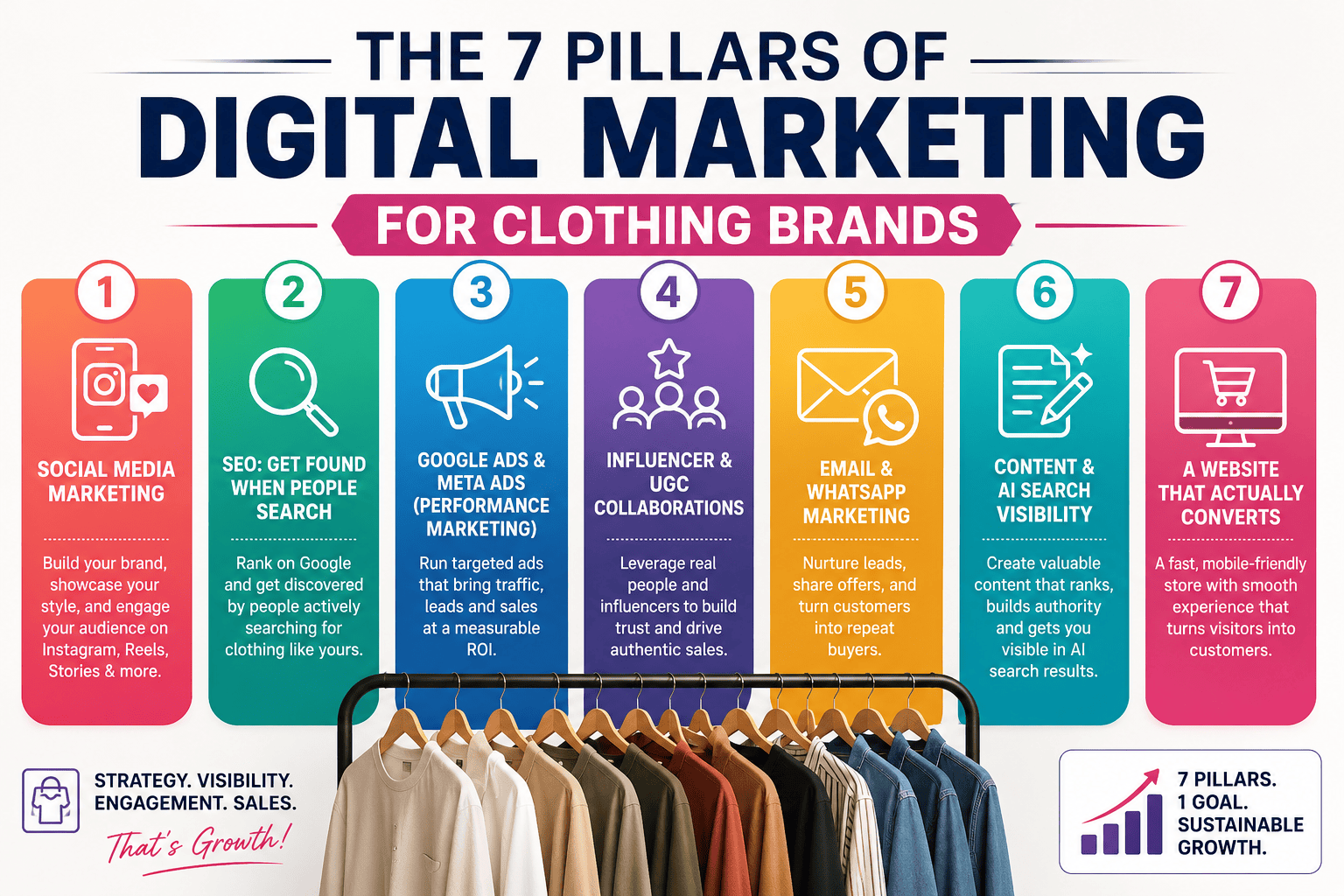
After years of running campaigns for fashion and lifestyle businesses, I’ve narrowed it down to seven pillars. You don’t need all seven on day one — but your clothing brand marketing strategy should have a plan for each.
1. Social Media Marketing for Clothing Brands
If you sell clothes in India, Instagram is your showroom. Reels are your window display. Stories are your salesperson.
Social media marketing for clothing brands works best when you stop posting like a catalogue and start posting like a creator. Product-only grids died years ago. What performs now: styling videos (“3 ways to wear this shirt”), behind-the-scenes from your workshop, transition Reels, honest fabric close-ups, and real customer content.
User-generated content (UGC) deserves special mention. Reposting genuine customers wearing your clothes builds more trust than any studio shoot — buyers want proof the outfit looks good on normal people, not just models. Social platforms are usually where digital marketing for clothing brands shows its first visible results, often within weeks.
I’ve written a full, India-specific breakdown in my guide on Instagram marketing for clothing brands — read it if Instagram is your main channel. And if you’d rather have this handled professionally, that’s exactly what our social media marketing team does every day.
2. SEO: Get Found When People Search
Instagram gets you discovered by accident. Google gets you discovered on purpose.
Someone typing “cotton co-ord sets for women” or “wedding sherwani under 15000” is ready to buy. SEO puts your product and collection pages in front of exactly those people — without paying per click. Optimise your product titles, write collection descriptions that answer real questions, publish styling blogs, and fix your site speed.
A quick tip: target long-tail phrases like “office wear kurtis under 1500” instead of broad terms like “kurtis” — smaller search volume, but far easier to rank for and much closer to a sale.
SEO is the slowest pillar of digital marketing for clothing brands, but it compounds. A page that ranks keeps sending free traffic for years, while an ad stops the moment you stop paying.
3. Google Ads and Meta Ads (Performance Marketing)
Paid ads are the accelerator. Meta ads (Facebook + Instagram) create demand by putting your designs in front of people who match your buyer profile. Google Shopping ads capture demand from people already searching for what you sell.
The most profitable ad type for most labels? Retargeting. The Baymard Institute’s research shows roughly 70% of online shopping carts are abandoned — retargeting ads bring a good chunk of those people back to finish the purchase. In digital marketing for clothing brands, retargeting is usually the first campaign I switch on, because it converts warm visitors instead of chasing cold strangers.
One warning: pressing “Boost Post” is not running ads. Proper campaigns are built in Ads Manager with clear objectives, audiences, and tracking.
4. Influencer and UGC Collaborations
The global fashion influencer marketing market was valued at about USD 6.82 billion in 2024 and is growing at a projected 33.8% CAGR — because it works.
You don’t need celebrities. Micro-influencers with 10,000–100,000 followers deliver better engagement per rupee, and many will collaborate on barter for a growing label. Send products to 10 creators whose audience matches yours, and reuse their content in your ads. In my experience, influencer content usually beats studio shoots in ad performance for digital marketing for clothing brands.
5. Email and WhatsApp Marketing (The Retention Engine)
Here’s the maths most brand owners miss: your first sale to a customer often just covers your ad cost. The profit is in the second and third sale — and that’s what email and WhatsApp are for.
Industry studies by Litmus put email’s return at roughly $36 for every $1 spent, and in India, WhatsApp open rates beat email comfortably. Collect numbers and emails at checkout, then use them: new drop announcements, back-in-stock alerts, order updates, festive offers. Retention is the least glamorous part of digital marketing for clothing brands and easily the most profitable.
6. Content and AI Search Visibility
This is the newest layer, and hardly any fashion label is doing it yet.
People now ask ChatGPT, Google’s AI Overviews, and Perplexity things like “best cotton co-ord sets under ₹2,000” — and the brands with clear, well-structured, genuinely helpful content are the ones AI tools mention. Style guides, size guides, fabric-care articles, honest FAQs: this content earns you visibility in both classic search and AI answers. Early movers in this part of digital marketing for clothing brands will enjoy an advantage that latecomers will pay heavily to catch up on.
7. A Website That Actually Converts
Instagram creates attention. Your website closes the sale.
A converting fashion store needs: fast loading (under 3 seconds), mobile-first design, clear size charts, real customer photos and reviews, easy checkout, and a WhatsApp button for size doubts. In India, cash on delivery still accounts for around 70% of D2C payments, per Mordor Intelligence — but COD return rates run 25–30%, so add WhatsApp order confirmation to filter casual orders.
This is exactly the kind of setup we build in our e-commerce marketing service — because traffic without conversion is just an expensive hobby. Your website is where digital marketing for clothing brands either pays off or quietly leaks money.
How to Promote Your Clothing Brand Online: A 90-Day Plan
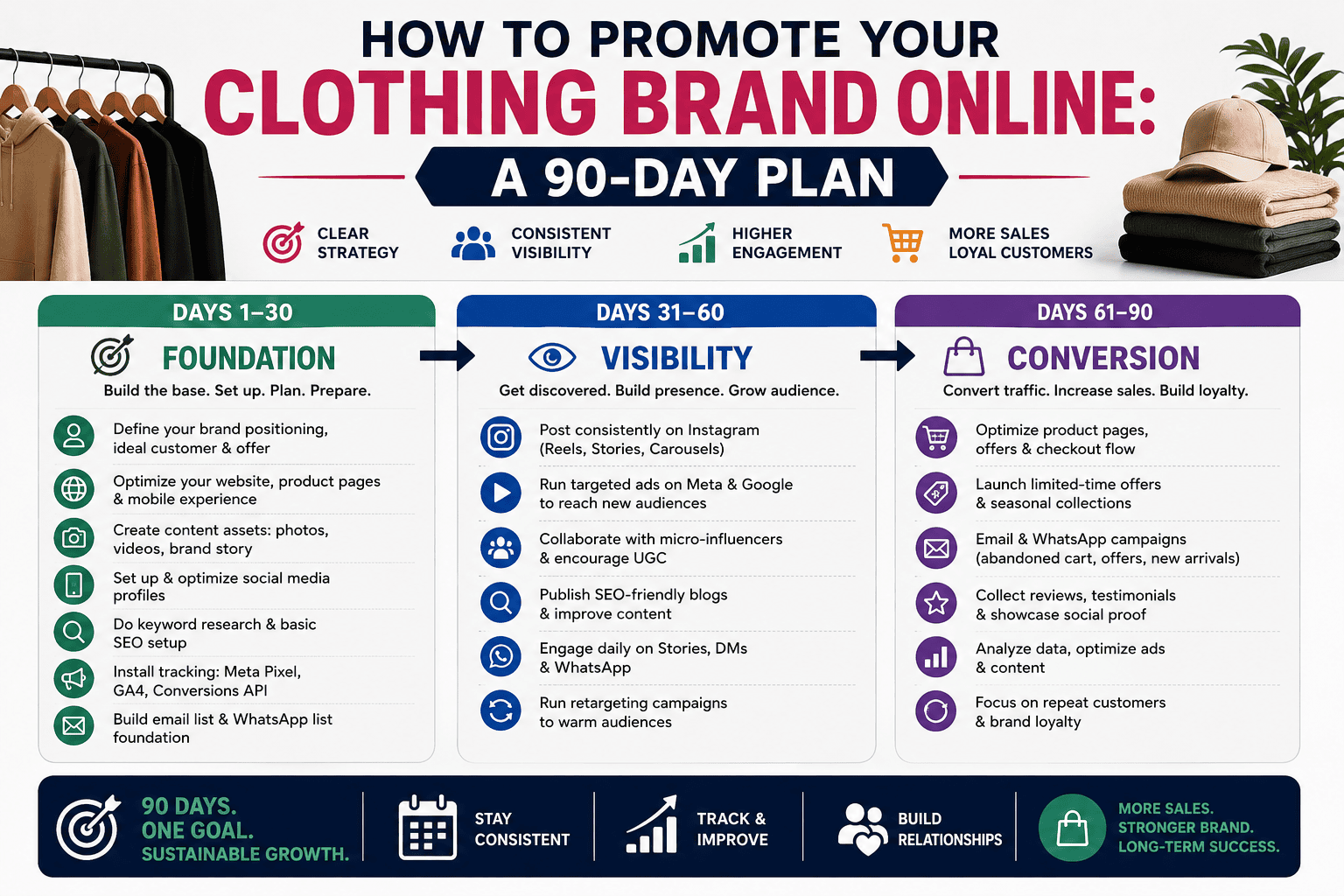
Most owners searching “how to promote clothing brand online” want a simple checklist, not theory. So here is the exact sequence I recommend when we start digital marketing for clothing brands from scratch.
Days 1–30: Foundation
- Fix your Instagram bio: who you’re for, what you sell, one clear link.
- Set up Google Business Profile, Search Console, and Meta Pixel tracking.
- Audit your website: speed, mobile view, size charts, WhatsApp button.
- Define 3 content pillars (styling, behind-the-scenes, customer stories) and shoot 15 Reels in a single day.
- Start collecting customer phone numbers and emails at every checkout.
Days 31–60: Visibility
- Post 4–5 Reels a week and 3 Stories daily. Consistency beats perfection.
- Launch your first Meta ad with ₹300–500 per day — start with traffic or engagement, not straight sales.
- Run 5 barter collaborations with micro-influencers in your niche.
- Publish 4 SEO blog posts targeting styling keywords your buyers search.
Days 61–90: Conversion
- Switch on retargeting ads for website visitors and Instagram engagers.
- Send your first WhatsApp broadcast for a new drop or restock.
- Collect reviews and customer photos; publish them on product pages.
- Double down on your best-performing content. Quietly drop the rest.
Ninety days won’t make you a household name, but it builds the machine. From there, digital marketing for clothing brands becomes a cycle of testing, measuring, and scaling what works.
What Results Should You Expect? (Honest Benchmarks)
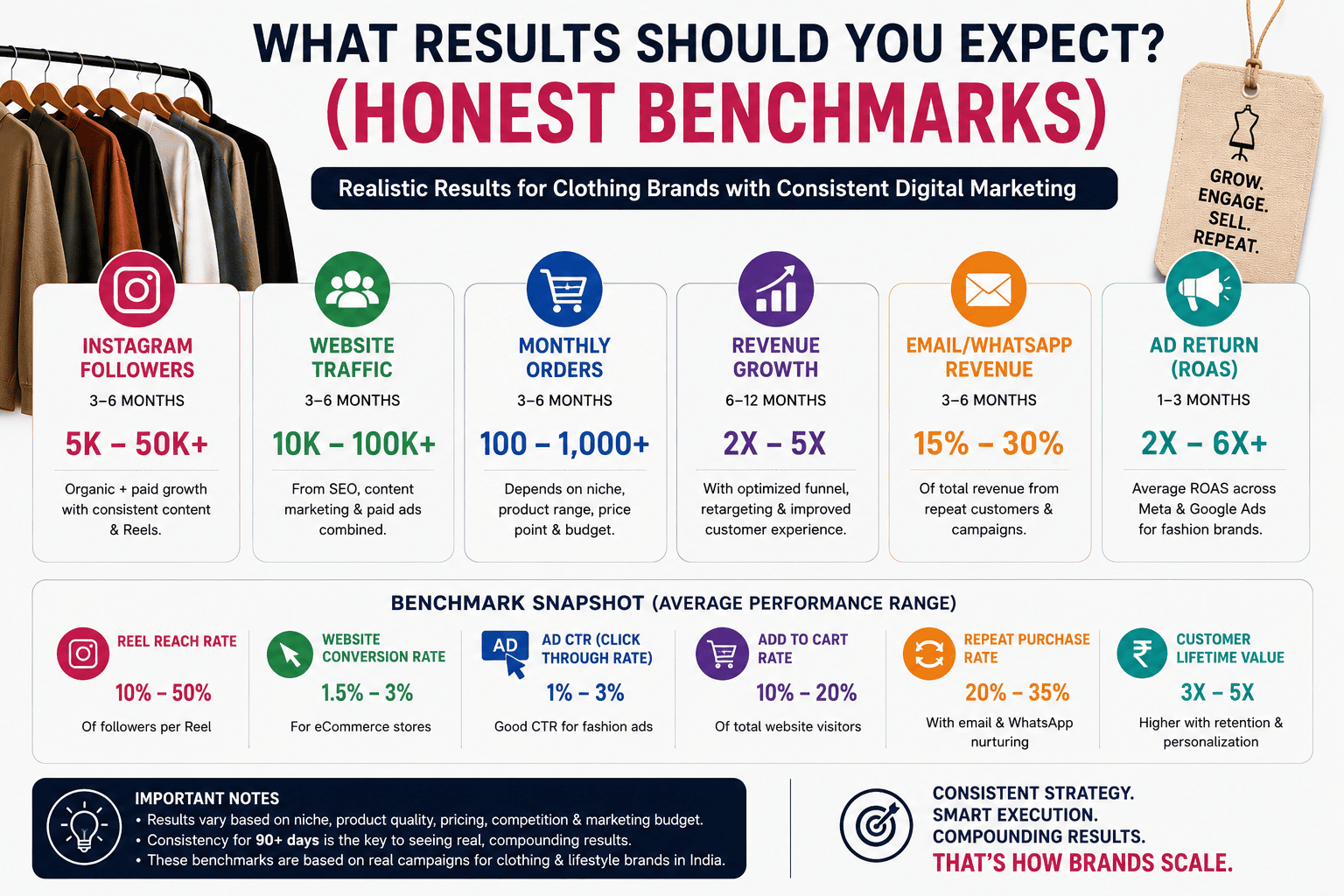
Numbers vary by price point, city, and category — but after auditing plenty of digital marketing for clothing brands campaigns, these are the starting ranges I trust:
| Metric | Healthy starting range |
|---|---|
| Fashion e-commerce conversion rate | 1–2% |
| Meta Ads ROAS (first 90 days) | 1.5–2.5x |
| Meta Ads ROAS (after optimisation) | 3x and above |
| Instagram engagement rate | 1–3% |
| Email + WhatsApp share of revenue | 15–25% |
| Customer acquisition cost | Under 30% of average order value |
If any agency promises you 10x ROAS in month one, walk away. Honest digital marketing for clothing brands is about compounding growth, not overnight miracles.
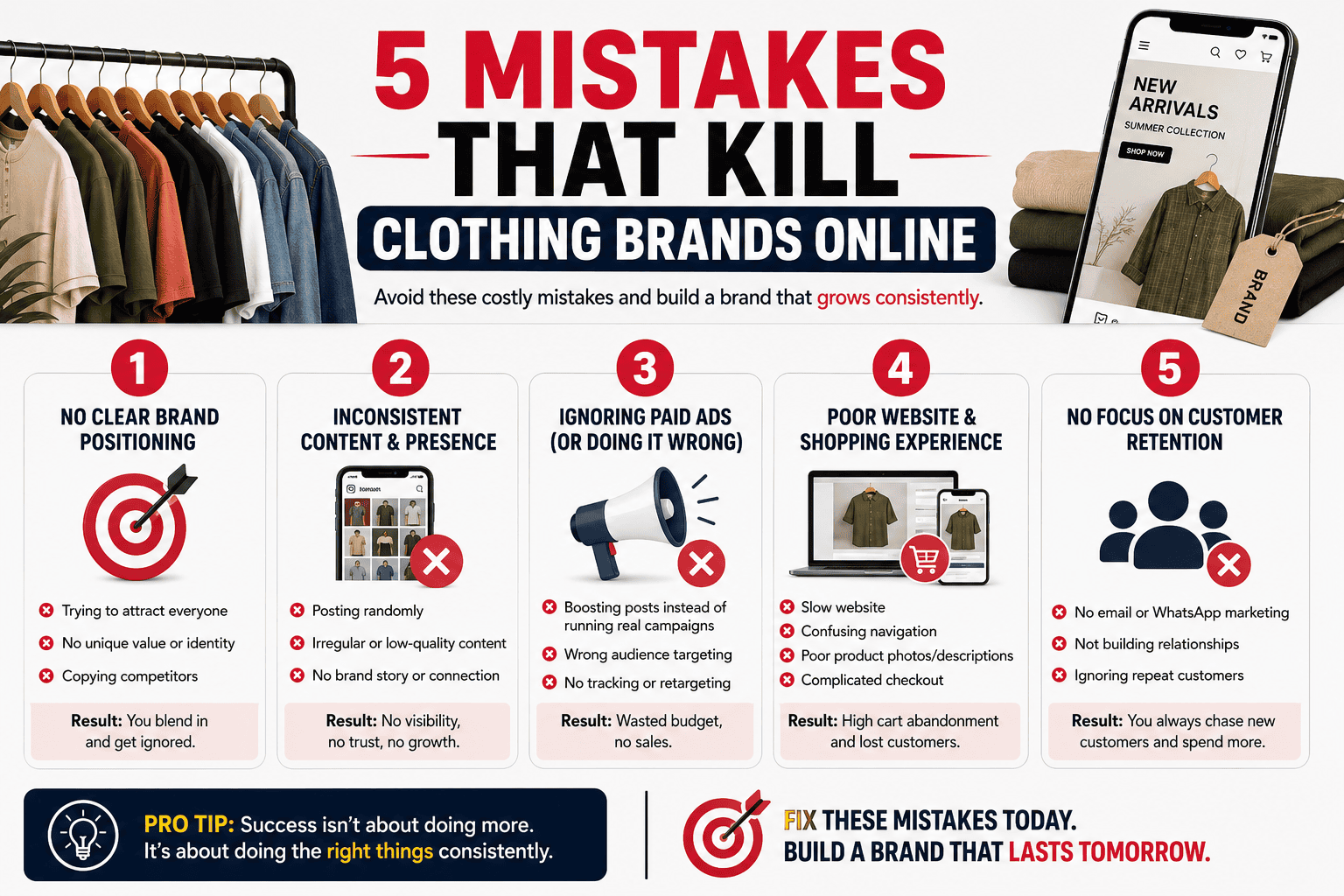
5 Mistakes That Kill Clothing Brands Online
I’ve audited enough fashion accounts to see the same patterns repeat:
- Posting without a strategy. Random content produces random results. Every post should serve discovery, trust, or sales.
- Boosting posts instead of running real campaigns. The boost button is the single biggest money-waster in digital marketing for clothing brands.
- Ignoring retention. Chasing new customers while your old customers forget you exist is expensive.
- Copying big brands. Zara can post plain product shots because everyone already knows Zara. You need story, face, and personality.
- Quitting in month two. Digital marketing for clothing brands compounds. Most owners give up at exactly the point where results were about to begin.
Should You Do It Yourself or Hire an Expert?
Honest answer: it depends on your stage.
DIY makes sense when your monthly revenue is under about ₹1 lakh, you have time to learn, and you can commit to one channel properly — usually organic Instagram plus WhatsApp. Plenty of founders run their first year of digital marketing for clothing brands this way, and it teaches you what your audience responds to.
Hiring help makes sense when you’re spending on ads without knowing your numbers, you’ve hit a revenue plateau, or content and marketing are eating the hours you should spend on product and operations. At that point, professional digital marketing for clothing brands stops being an expense and becomes the highest-ROI hire you’ll make.
What does it cost in India? Broadly: freelancers charge ₹8,000–20,000 per month, and agency retainers for social media or SEO typically run ₹15,000–50,000 per month, with ad budget separate. I’ve published a complete, transparent breakdown in my digital marketing cost guide so you can budget without guesswork.
What to look for before you sign with anyone:
- Real experience with fashion, apparel, or D2C brands — ask for examples.
- Clear monthly reporting on traffic, leads, ROAS, and sales, not vanity metrics.
- Questions about your margins and repeat rate. If they only talk followers, run.
- No “guaranteed results” claims. Nobody ethical guarantees fixed numbers.
Choose right, and digital marketing for clothing brands becomes a partnership that pays for itself. Choose wrong, and you’ll join the owners who tell me “we tried an agency once, it didn’t work.
What I've Seen Working With Brands (My Take)
A personal note from running JD Digital Marketing in Ahmedabad.
The clothing labels that grow are almost never the ones with the biggest budgets. They’re the ones where the founder shows their face on camera, replies to DMs personally in the early days, treats content with the same seriousness as fabric selection, and stays consistent for six months minimum. Gujarat has world-class garment manufacturing — Surat literally clothes the country — yet so many talented makers stay invisible because they treat marketing as an afterthought.
My process with every fashion client follows the same four steps we use across the agency: discovery, strategy, execution, and transparent reporting. No jargon, no drama — just digital marketing for clothing brands run like a system, reviewed every month against real sales numbers.
If that sounds like the kind of partner you’re looking for, my door (and my WhatsApp) is open.
Frequently Asked Questions
For a small-to-mid label, expect ₹8,000–20,000 per month for a freelancer or ₹15,000–50,000 per month for an agency retainer, plus a separate ad budget — most brands start with ₹9,000–30,000 monthly ad spend and scale what works.
Start with Instagram — it’s where fashion discovery happens. Add Meta ads once your content converts, Google Ads once your website is solid, and WhatsApp for repeat sales. In digital marketing for clothing brands, one platform done well beats five done half-heartedly.
Paid ads can produce sales within 2–4 weeks. Organic social growth typically becomes visible in 6–8 weeks of consistent posting. SEO takes 3–6 months but keeps compounding after that.
Yes, especially early on. Focus on Instagram Reels, customer content, and WhatsApp follow-ups. Hire help when ad spend, tracking, and content volume grow beyond what you can manage alongside running the business.
It does — it’s just slower than ads. Optimised product pages, collection pages, and styling blogs bring buyers who are actively searching, and that traffic keeps arriving long after the work is done. It’s the patient side of digital marketing for clothing brands.