
How AI Helps Digital Marketing Today — Ahmedabad Guide
AI is reshaping how businesses run AI for digital marketing, from automating routine tasks to personalizing campaigns at scale. For Ahmedabad-based SMEs and startups, the question is no longer whether to use AI but how to adopt tools in a way that fits budgets, local markets and compliance requirements.
AI reduces repetitive work, surfaces insights from messy data and lets small teams deliver more targeted SEO, ads and content—if they follow a clear pilot plan.
Key takeaways
- AI improves efficiency (automation), personalization (better audience fit) and scale (repeatable processes).
- Start with audits and a short pilot (30–90 days) before wider rollout to limit risk and measure impact.
- Practical tools include Google AI features, AI writing assistants, automated SEO auditors and chatbot platforms with Gujarati/Hindi support.
- JD Digital Marketing runs affordable, ROI-focused pilots for Ahmedabad SMEs—contact the founder via Contact JD Digital Marketing.
Introduction: Why AI matters for digital marketing in the current situation
Marketing teams in Ahmedabad face tighter budgets, rising ad costs and higher expectations for measurable results. AI helps reduce the time spent on repetitive analyses and enables more targeted outreach without proportional increases in headcount.
For many SMEs the practical benefit is clearer reporting and faster iteration: AI for Digital Marketing an automated SEO audit or an AI-suggested ad headline can be tested within days. Those quick cycles lead to small, compound gains that matter for local businesses competing on price and reach.
- Start small: choose one use case (SEO, ads, or chat) and measure a single KPI.
- Keep human review central: AI suggests; people verify for brand fit and accuracy.
Overview — state of digital marketing in Ahmedabad, Gujarat, India (2026 context)
Ahmedabad’s digital market has matured since 2020: more SMEs are online, local ad inventory on Google and Meta has become pricier, and customers expect faster responses. Gujarat’s startup ecosystem has pushed demand for measurable lead-gen and scalable social campaigns.
Local businesses still face practical constraints—limited analytics maturity, mixed data quality and small teams. That environment makes Ahmedabad a good fit for staged AI adoption: automations that lower manual work and dashboards that provide clear ROI signals.
Examples: JD Digital Marketing works with local clients such as Strivon (end-to-end social and SEO) and Dev Aamrakunj Platinum (lead-gen via Meta) where AI-assisted bidding and creative testing were folded into performance retainers to reduce CPA and improve engagement metrics.
Key benefits of AI for digital marketing (efficiency, personalization, scaling)
AI concentrates value in three areas: it automates repetitive tasks, personalizes messaging at scale and makes basic predictive work feasible for small teams. Together, these reduce cost-per-action and increase the speed of learning.
- Efficiency: automated audits, tagging, and reporting free up specialists for strategy work.
- Personalization: dynamic content and audience segmentation that adjusts in real time.
- Scaling: repeatable templates and models let SMEs run more campaigns without doubling staff.
Practical example: an e-commerce store in Ahmedabad can use an AI recommendation model to increase average order value while a rules-based email sequence handles follow-ups automatically.
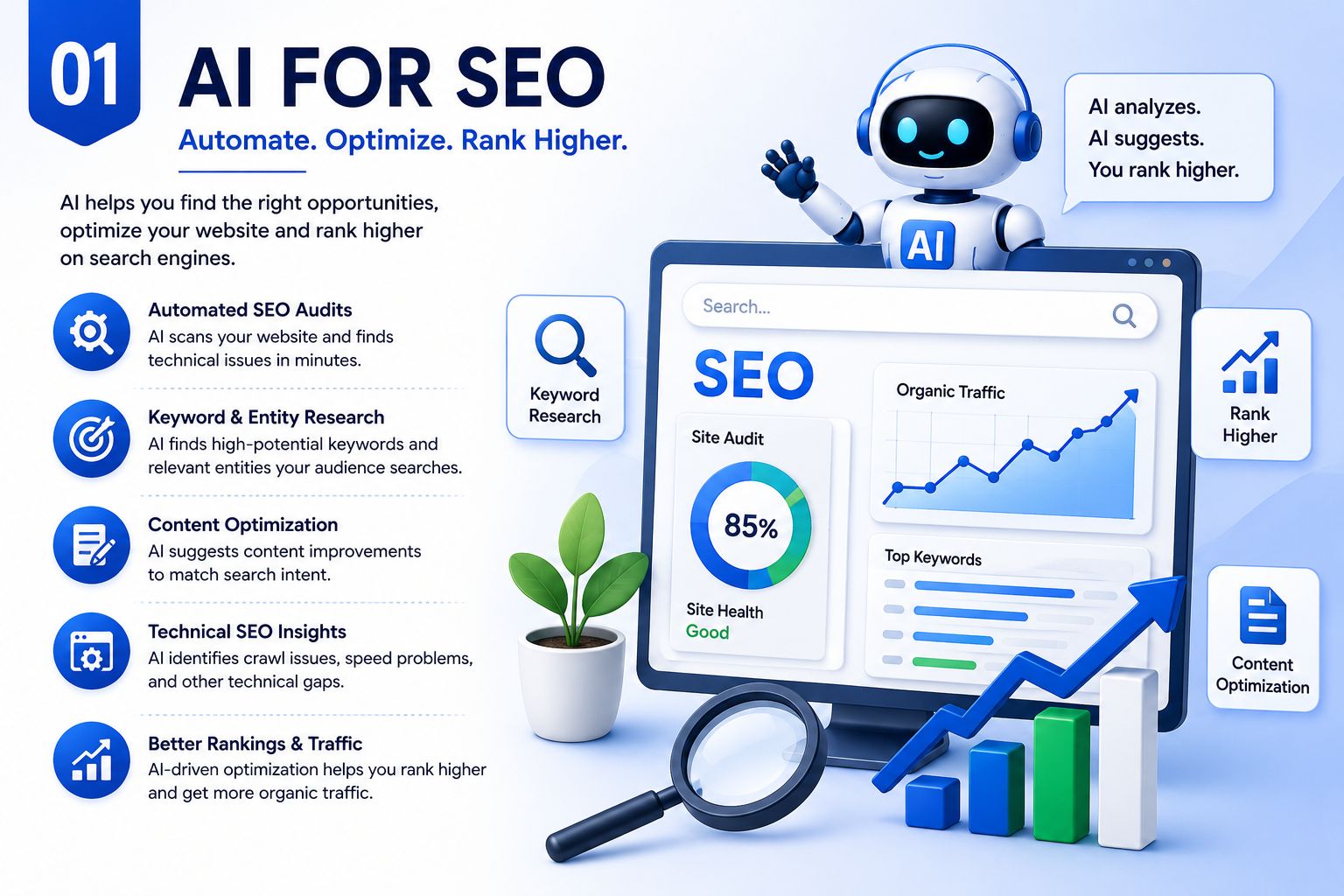
AI for SEO: automated audits, content optimization, entity targeting
AI helps SEO teams by quickly surfacing technical issues, suggesting content topics and tuning on-page elements for intent rather than just keywords. Tools with NLP-based features can detect entity relationships and recommend structured data that helps local search visibility.
Steps to apply AI for SEO:
- Run an automated technical audit (crawl, mobile usability, core web vitals).
- Use NLP tools to extract user intent and topic clusters from SERPs and FAQs.
- Generate and human-edit content outlines; add structured data for local business and product pages.
- Monitor rankings and traffic for anomalies and iterate weekly.
Real example: use an automated auditor to find duplicate meta tags, then apply a content brief generated by an AI writing assistant. Human editors adjust tone for Ahmedabad audiences and check local terms (Gujarati/Hindi) when needed. For reference on AI fundamentals see Artificial intelligence — Wikipedia.
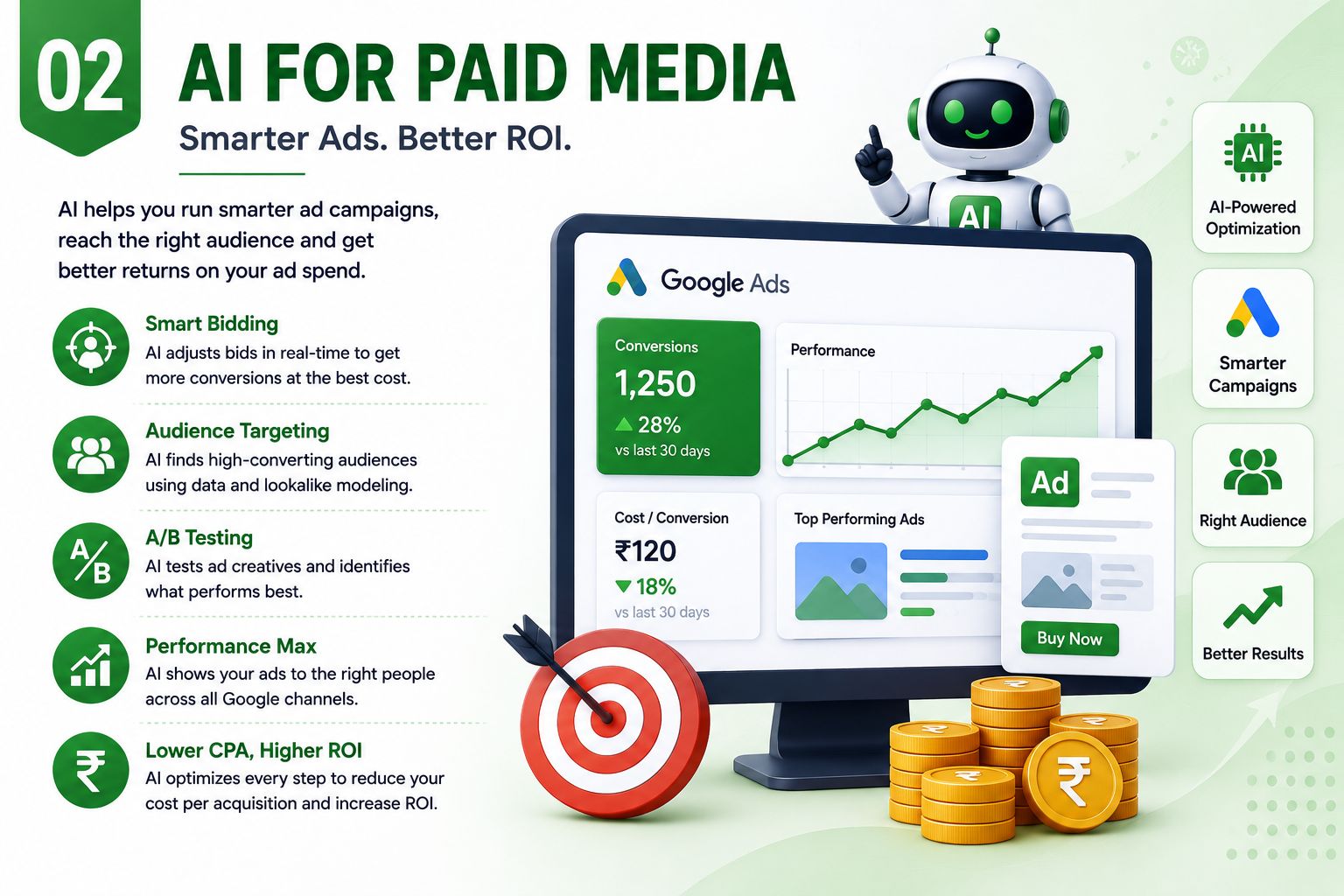
AI for Paid Media (Google Ads & programmatic): bidding, creative A/B, audience modeling
AI in paid media focuses on optimization: automated bidding algorithms, creative rotation and audience suggestions. Google Ads offers Smart Bidding and Performance Max features; programmatic platforms use lookalike and propensity models to find buyers across inventory.
Implementation steps:
- Define a clear conversion signal (lead form, purchase, phone call).
- Run a short A/B test with AI-powered creative variants and measure CPA differences.
- Move high-performing audiences to scaled campaigns with automated bidding and caps to control spend.
Example: JD Digital Marketing used audience segmentation and creative testing to lower CPL for a real estate client; Meta campaigns produced large lead volumes with a low per-lead cost where automated rules paused underperforming ad sets.
For platform-level AI updates see resources such as Google AI and industry coverage at Search Engine Land — AI in Marketing.
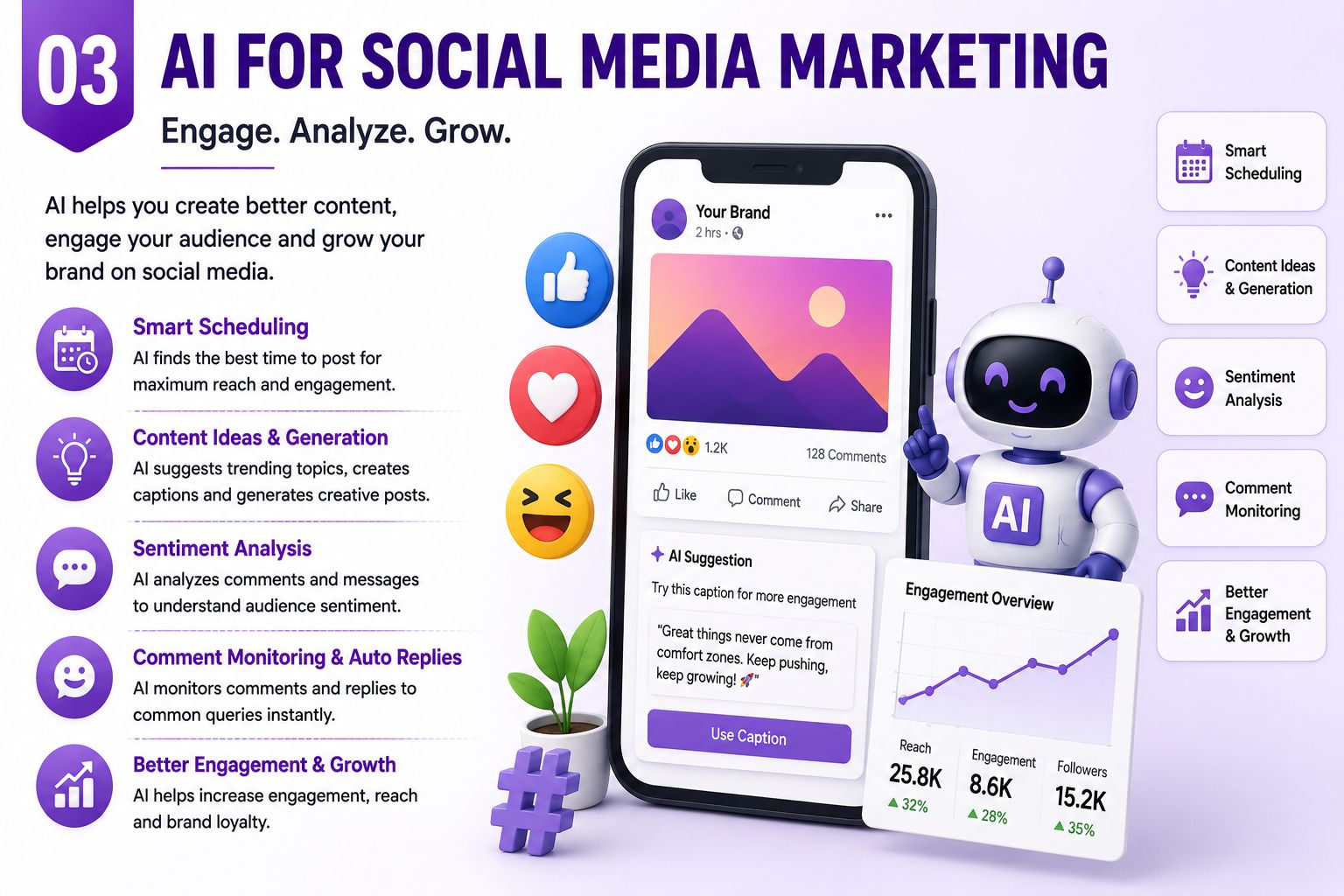
AI for Social Media Marketing: scheduling, creative generation, sentiment analysis
Social teams use AI to schedule posts at optimal times, produce caption drafts and scan comments for sentiment. For local markets, the ability to detect language variations and local slang matters for brand safety and tone.
- Use AI to suggest post times and topics based on engagement signals.
- Generate multiple caption variants, then edit to reflect brand voice and local nuance.
- Run sentiment analysis to quickly flag service issues and escalate high-risk comments to support teams.
Real example: scheduling plus A/B caption testing can reduce time to publish while maintaining higher engagement. For Ahmedabad clients, include local festival calendars and city-specific offers in the content plan to increase relevance.
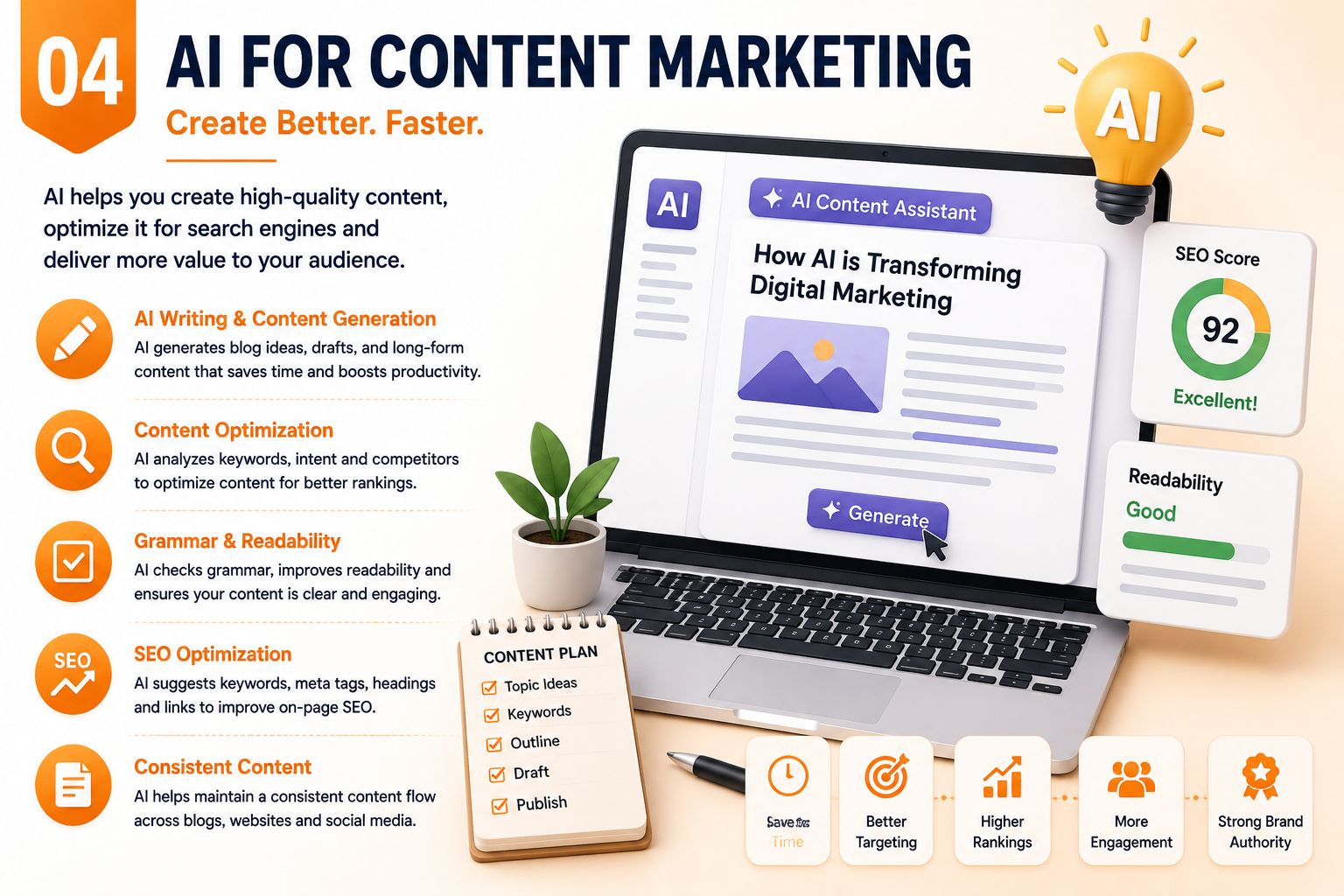
AI for Content Marketing & Copywriting: generative content, quality control, plagiarism checks
Generative tools speed up first drafts for blogs, ad copy and product descriptions. The best practice is to treat AI as a co-writer: produce an initial draft, run quality checks and then human-edit for accuracy, tone and local context.
Practical steps:
- Create a content brief that includes target keywords, audience persona and required local terms (e.g., Ahmedabad, Gujarat).
- Generate a draft with an AI writing assistant and run it through a plagiarism checker and readability tool.
- Fact-check, localise (currency, place names, festivals) and approve before publishing.
Example: JD Digital Marketing produced SEO-friendly drafts for Strivon, then added Ahmedabad-specific service mentions and local trust signals before publishing to increase relevance for local searches.
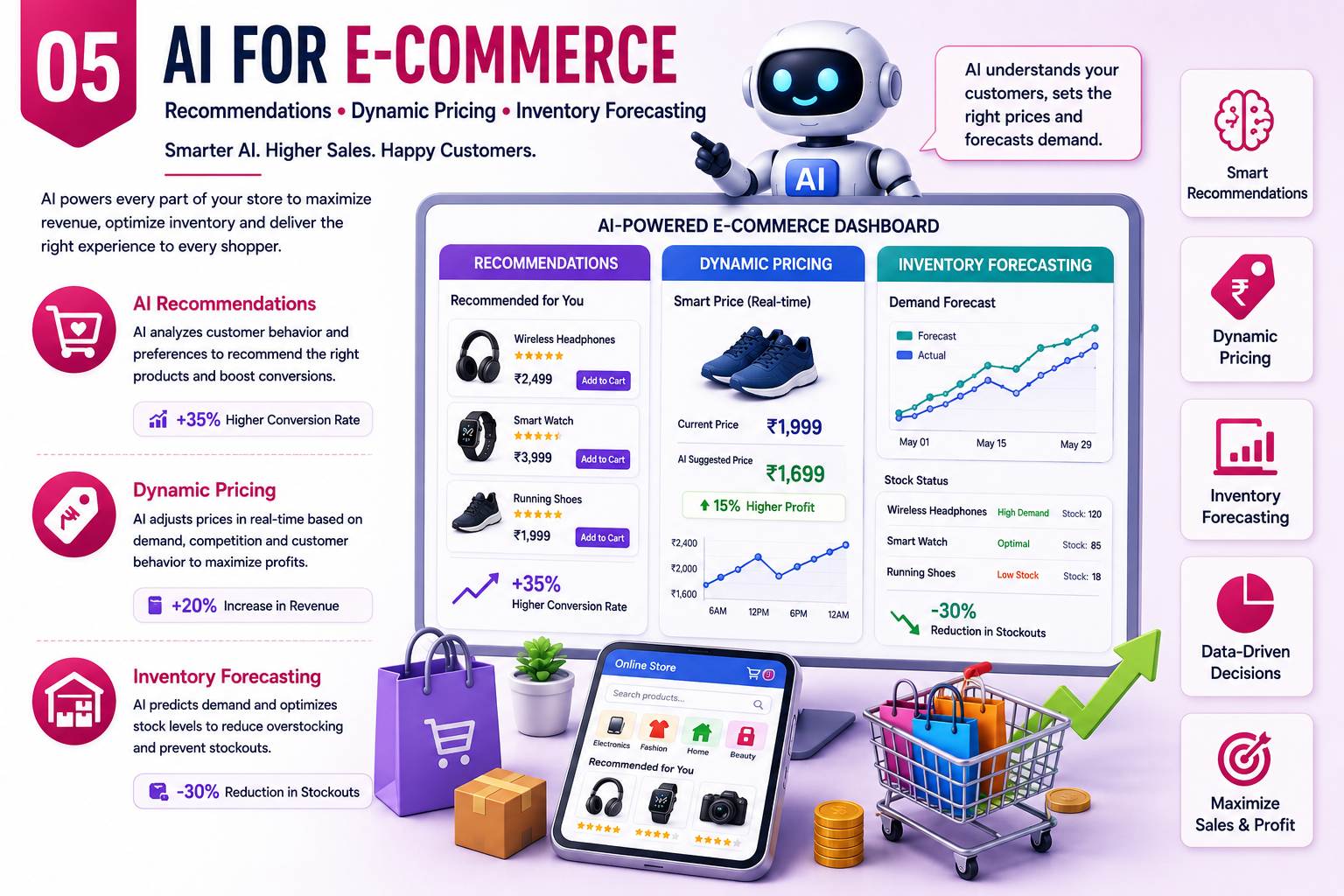
AI for E-commerce: recommendations, dynamic pricing and inventory forecasting
For online stores, recommendation systems and dynamic pricing models can materially increase average order value and reduce stockouts. Forecasting that uses sales history and seasonal trends helps SMEs plan procurement for festivals and sales cycles common in Gujarat.
- Start with basic product recommendation rules (frequently bought together).
- Pilot a dynamic pricing rule for a subset of SKUs during a sale window and measure margin impact.
- Use simple demand-forecasting models to set reorder points ahead of peak seasons.
Real example: a local retailer might use AI to prioritize inventory for Navratri and Diwali, ensuring high-demand SKUs are promoted and restocked in time to avoid lost sales.
AI for Design & Creative (graphics, video): tools, workflows, speed vs quality tradeoffs
Design tools with AI features speed up asset creation: templates, background removal, auto-resize and quick video edits. These features are useful for SMEs that need many variations (ad sizes, thumbnail tests).
Workflow steps:
- Use an AI-assisted tool for first-pass creative (thumbnail, headlines, layouts).
- Have a designer refine high-impact creatives to maintain brand standards.
- Run small creative A/B tests to measure lift before scaling layouts across campaigns.
Example: tools like Canva or Runway can generate quick designs; JD Digital Marketing balances quick generation with designer review for client campaigns to keep visual quality consistent.
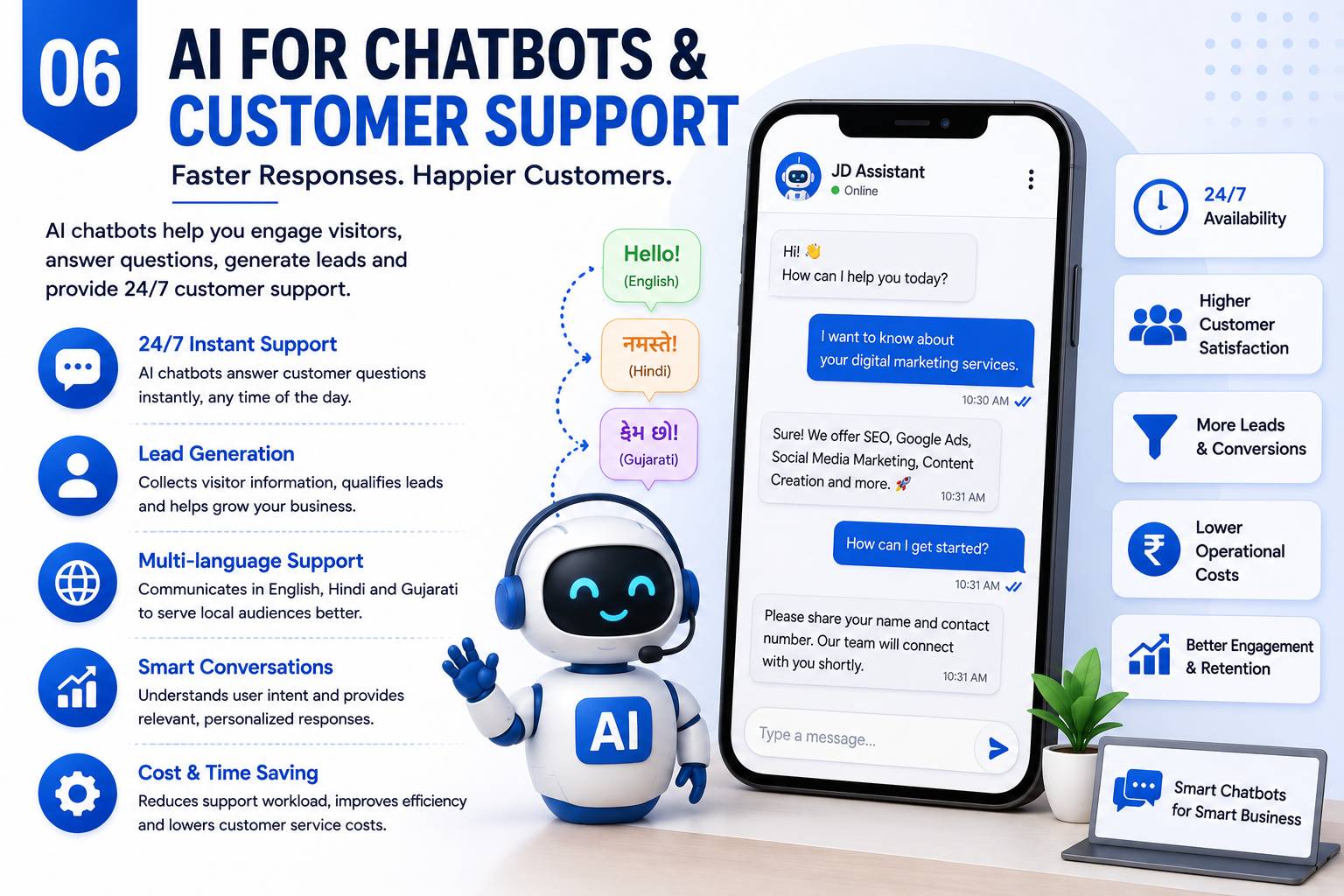
Customer Experience & Chatbots: conversational AI, lead qualification, local language support
Conversational AI speeds up response times and qualifies leads before passing them to sales. For Ahmedabad audiences, support for Gujarati and Hinglish/Indian-English improves completion rates and reduces friction.
- Define the bot’s scope: lead capture, FAQ, booking or support.
- Train the bot with local phrases and test in both Gujarati and Hindi where relevant.
- Implement escalation paths to humans for pricing or negotiation queries.
Real example: a lead-gen bot on a property landing page can collect budget and contact details, and schedule a call—freeing sales teams to focus on hot leads. JD Digital Marketing configures simple qualification flows for real-estate and service clients to raise lead quality.
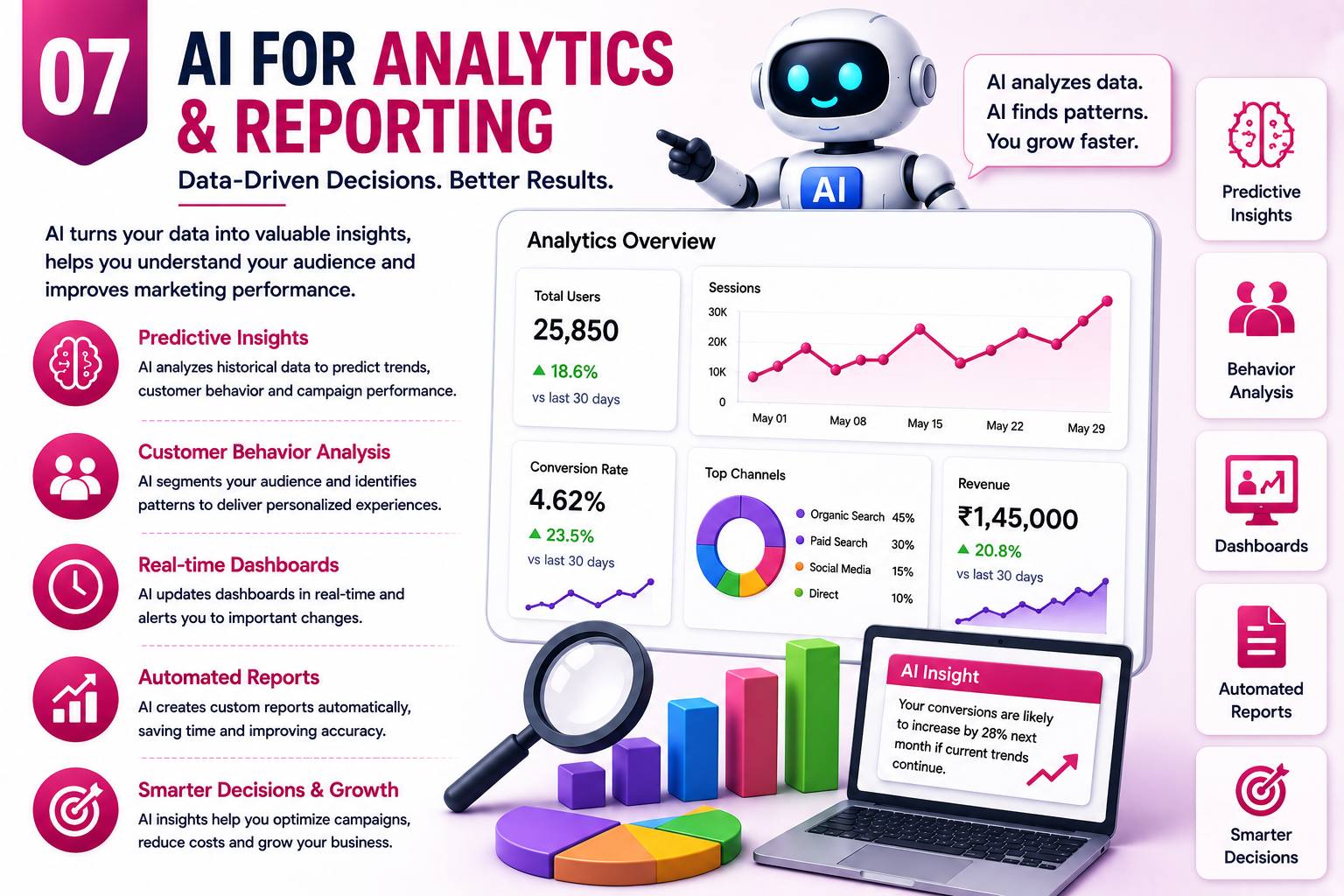
Data & Analytics: predictive attribution, anomaly detection, dashboard automation
AI in analytics provides predictive signals—who is likely to convert—and detects anomalies in traffic or campaign performance. Automating dashboards and alerts reduces the chance that a low-traffic day or a sudden spike goes unnoticed.
Steps to get started:
- Clean the core data sources and set up consistent event tracking (GA4, CRM, ad platforms).
- Use anomaly detection to catch sudden drops in conversion rate or spikes in CPC.
- Build simple predictive models (likelihood to convert) and add them to lead scoring processes.
Example: export ad and CRM data to a sheet or BigQuery, run a simple model to rank leads by conversion probability, and surface the top 10% to sales. That concentrates limited sales effort on the most likely buyers and can be implemented with modest budgets.
Implementation Roadmap for Ahmedabad businesses: audit → pilot → scale
Start with a short, focused audit that maps current channels, data sources and KPIs. For most Ahmedabad small and mid-sized businesses this is a one-week activity: inventory analytics accounts, CRM fields, ad accounts, existing content and technical SEO. The goal is a prioritized list of hypotheses (for example: “improving organic title tags will increase qualified traffic for product X”).
Next, run a 60–90 day pilot on one channel or use case. Common pilots: AI-assisted SEO content optimization for a product category, automated bidding and creative testing for a Google Ads campaign, or a conversational chatbot for lead qualification in Gujarati and English. Keep pilots small: one landing page cluster, one campaign, or one chatbot flow. Define clear success metrics in advance (see Measurement & KPIs section).
If the pilot shows measurable improvement vs baseline, move to scale in 3 phases: operationalize (process, roles and tools), automate safe parts (reporting, bidding rules, personalization segments), and iterate with continuous validation. Maintain human review for creative output and final campaign approvals. For help with auditing or pilots, see our services: Digital Marketing Services in Ahmedabad.
Tools Stack: recommended AI tools for small businesses and agencies (SEO, ads, content, analytics)
Choose tools by function, not brand. For SEO: automated crawlers and content assistants that support entity-based optimization are most useful. For ads: platforms that offer transparent automated bidding and experiment controls. For content: generative tools with quality controls and plagiarism checks. For analytics: lightweight platforms that enable anomaly alerts and predictive segments.
Examples to evaluate (each has documentation and enterprise options): Google AI for data and ML APIs, open-source models for on-premise privacy-sensitive tasks, dedicated SEO tools with AI features, and smaller SaaS providers that focus on automation for SMBs. Use Search Engine Land’s library for market context: Search Engine Land — AI in Marketing.
For Ahmedabad teams, prefer tools with easy integrations to Google Analytics/GA4, Google Ads, and your CMS. Where data residency is a concern, select vendors with clear data handling terms or use server-side deployments.
Measurement & KPIs: how to track AI impact (LTV, CAC, conversion lift, efficiency gains)
Define 3 types of KPIs before you start: outcome, efficiency and quality.
- Outcome KPIs: conversion rate, revenue per visitor, average order value, long-term metrics like LTV. These show business impact.
- Efficiency KPIs: cost per conversion (CAC), staff hours saved, time-to-creative. These show operational gain from automation.
- Quality KPIs: content relevance scores, percentage of approved AI drafts, chatbot lead qualification accuracy.
Use controlled experiments where possible—A/B tests or holdout groups—to isolate AI effects. For paid media, measure conversion lift against a baseline period and adjust for seasonal effects. For SEO pilots, compare organic uplift across similar pages or keywords, and track indexation and ranking trends over 60–90 days.
Compliance, Privacy & Ethics: data handling, consent and biases in marketing AI
Indian data protection law continues evolving. Treat customer data carefully: minimise PII (personally identifiable information) in model training, use hashed identifiers for ad audiences, and avoid storing sensitive personal data in third-party tools unless contractually permitted.
Obtain explicit consent for messaging and respect unsubscribe requests. If you process personal data across borders, check vendor terms and use data processing agreements. For model fairness, monitor outputs for biased language or targeting that could exclude groups. Keep human review as the final gate for customer-facing content and targeting decisions.
For technical background on AI, see Artificial intelligence — Wikipedia. For vendor-specific safety and policies, consult provider documentation (for example, Google AI guidance at Google AI).
Common pitfalls and how to avoid them (over-reliance, poor data, lack of human review)
Most failures come from three sources: bad data, unclear goals, and skipping human oversight. Bad data produces poor predictions and noisy personalization. Clear the basics first: clean analytics setup, consistent naming conventions and reliable conversion tagging.
Set measurable, limited-scope goals for pilots and avoid wholesale automation of core decisions. For example, allow AI to suggest ad creatives but require human approval for live changes in the first two quarters. Log decisions and outcomes so you can audit model suggestions and correct course.
Finally, build a small governance routine: weekly review of model outputs, monthly KPI checks, and quarterly model re-training or rule updates.
Local Case Study Spotlight: JD Digital Marketing — AI applied to SEO, Google Ads and content
At JD Digital Marketing we run local pilots that combine automated SEO audits, generative-first drafts for product pages and experiment-driven Google Ads bidding. Our typical approach for an Ahmedabad SME: run a 60-day SEO content pilot for a single category, measure organic impressions and qualified leads, then introduce AI-assisted bidding for top-performing SKUs.
We balance automation with manual control. Content drafts are generated and then edited by writers to add local context, product specifics and Gujarati phrases where appropriate. For Google Ads, we test automated bidding in a limited campaign with a fixed budget and a holdout control group to measure true lift. Results vary by sector—e-commerce pilots typically show faster measurable revenue impact than long sales-cycle B2B—but the method remains the same: small pilots, clear KPIs and phased scaling.
If you want to discuss a pilot, see our pricing overview at Digital Marketing Cost in Ahmedabad or contact us directly: Contact JD Digital Marketing.
Pricing Models for AI-enabled services and expected ROI for Ahmedabad SMEs
Common pricing models you’ll encounter:
- Fixed-price pilots: clearly scoped outcomes for 60–90 days. Good for first-time adopters.
- Retainer + performance bonus: monthly fee covering operations plus a bonus tied to specific KPIs (e.g., cost-per-lead improvements).
- Project-based builds: a one-time setup fee for data integration, model configuration and training, plus optional support.
Expected ROI depends on the channel. For paid media, automation often improves CAC by 10–30% in early projects when properly measured. For SEO and content, ROI timelines are longer—3–9 months—but can produce higher LTV improvements. Always ask vendors for sample case studies and a realistic forecast tied to your traffic, average order value and margins.
How to choose a partner: checklist for hiring an AI-capable marketing agency in Ahmedabad
Use this checklist when vetting agencies:
- Case studies with measurable outcomes (not just screenshots).
- Data access and security practices—can they sign a data processing agreement?
- Clear pilot scope and success metrics.
- Tool transparency—what vendors and models do they use?
- Local language capability for Gujarati/Hinglish if your audience needs it.
- Staffing—who will monitor outputs and what are their roles?
- Pricing clarity—fixed-scope vs retainer, and exit terms.
JD Digital Marketing provides case studies and a clear pilot scope; see our SEO offerings at SEO Services in Ahmedabad.
Actionable 90-day plan: quick wins, pilot projects and scaling steps
Days 1–14: Audit and hypothesis prioritization. Clean tagging, define KPIs, choose one channel for a pilot.
Days 15–60: Run pilot (content optimization, ad experiment, or chatbot). Track outcome and efficiency KPIs weekly. Keep the pilot small and track a control group.
Days 61–90: Review results, operationalize wins (document processes, assign roles), and prepare a scale plan. If performance meets targets, expand to adjacent categories or campaigns and add automation for reporting and routine tasks.
Resources & training for teams: courses, communities and documentation
Recommended starting points:
- Official documentation from major platforms (Google AI and Google Ads learning paths): Google AI.
- Industry reading: Search Engine Land — AI in Marketing.
- Short practical courses from recognised providers—look for modules on AI for marketing, model evaluation and data privacy. Local workshops and meetup groups in Ahmedabad occasionally run hands-on sessions; check community calendars and LinkedIn groups.
Conclusion: pragmatic adoption for sustainable growth
AI can be highly useful for digital marketing today, but the advantage comes from disciplined pilots, clean data and human oversight. Start small, measure clearly, and scale what works. If you want a practitioner who builds pilots and helps operationalize AI in Ahmedabad, get in touch: Contact JD Digital Marketing.
Author: Jaymeen Dodiya, Founder, JD Digital Marketing
This article was written by the founder of JD Digital Marketing. Rankings are based on publicly available information, service comparison and editorial opinion. JD Digital Marketing is included and clearly disclosed; no other agency paid for placement.