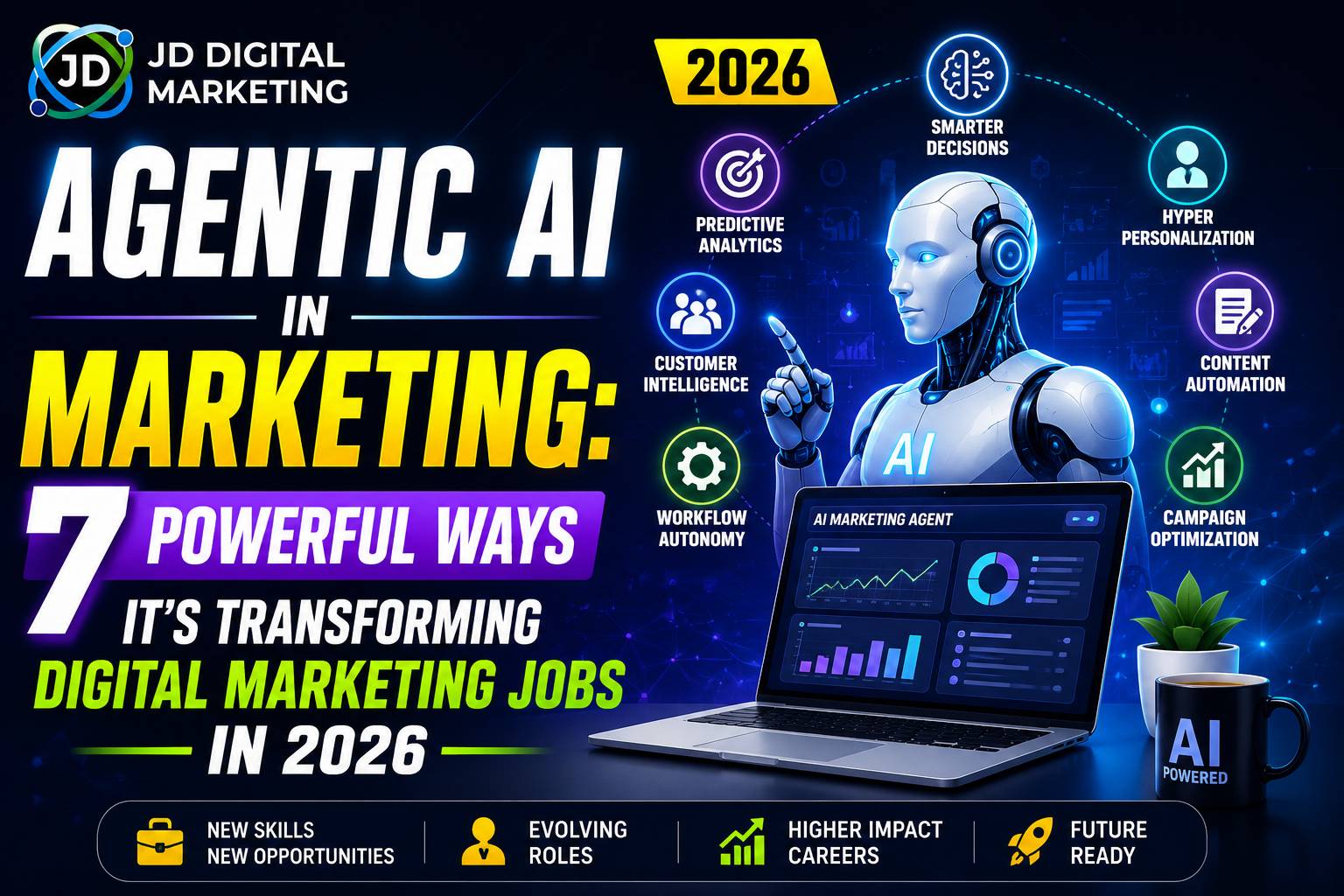
Artificial intelligence has evolved far beyond being a simple tool that responds to commands. In 2026, the marketing landscape is shifting from AI assistants that provide recommendations to autonomous AI systems capable of planning, analyzing, and executing marketing tasks with very little human involvement. This new evolution is known as agentic AI in marketing, and it is fundamentally changing the way businesses drive growth, engage customers, and manage campaigns.
From content marketing and search engine optimization to paid advertising and customer journey management, agentic AI enables marketers to achieve stronger results while eliminating repetitive manual work. As AI adoption continues to accelerate, one question is becoming increasingly important for marketing professionals:
How will agentic AI reshape digital marketing careers in the years ahead?
In this guide, you’ll discover what agentic AI means, how it differs from traditional AI systems, and the seven major ways it is transforming the digital marketing industry in 2026.
Table of Contents
ToggleWhat Is Agentic AI in Marketing?
Agentic AI in marketing refers to intelligent systems that combine artificial intelligence, machine learning, automation, and autonomous decision-making into one integrated solution. Rather than waiting for instructions from users, these systems can independently identify opportunities, make decisions, and complete tasks based on predefined business objectives.
Unlike conventional AI tools that simply assist marketers, agentic AI takes initiative by continuously monitoring performance, adapting to changing conditions, and executing actions without constant supervision.
A Simple Example
Suppose you launch a Google Ads campaign.
With a traditional AI solution, you might receive suggestions for improving keywords or campaign settings.
An agentic AI system, however, can automatically:
- Evaluate campaign performance
- Pause ads that aren’t delivering results
- Increase budgets for high-performing campaigns
- Produce fresh ad variations
- Generate detailed performance reports
—all without requiring marketers to manually perform each task.
This ability to independently analyze and act makes agentic AI one of the most significant innovations shaping AI-powered digital marketing today.
Agentic AI vs Traditional AI in Marketing
Although both technologies rely on artificial intelligence, they differ significantly in how they operate.
Feature | Traditional AI | Agentic AI |
Decision Making | Requires human approval before action | Makes decisions independently |
Automation | Automates selected tasks | Handles complete workflows |
Human Involvement | High | Moderate to Low |
Campaign Management | Suggests recommendations | Executes recommendations automatically |
Optimization | Based on predefined rules | Continuously adapts and learns |
Learning Capability | Limited | Improves over time through continuous learning |
The key distinction is simple: traditional AI supports marketers with recommendations, whereas agentic AI actively works toward achieving marketing goals by taking action on its own.
Why Agentic AI Matters in 2026
Marketing has never been more complex than it is today.
Modern businesses are expected to manage:
- Multiple advertising platforms
- Diverse customer audiences
- Huge volumes of marketing data
- Highly personalized customer experiences
- Continuous campaign optimization in real time
Handling all of these responsibilities manually has become increasingly difficult.
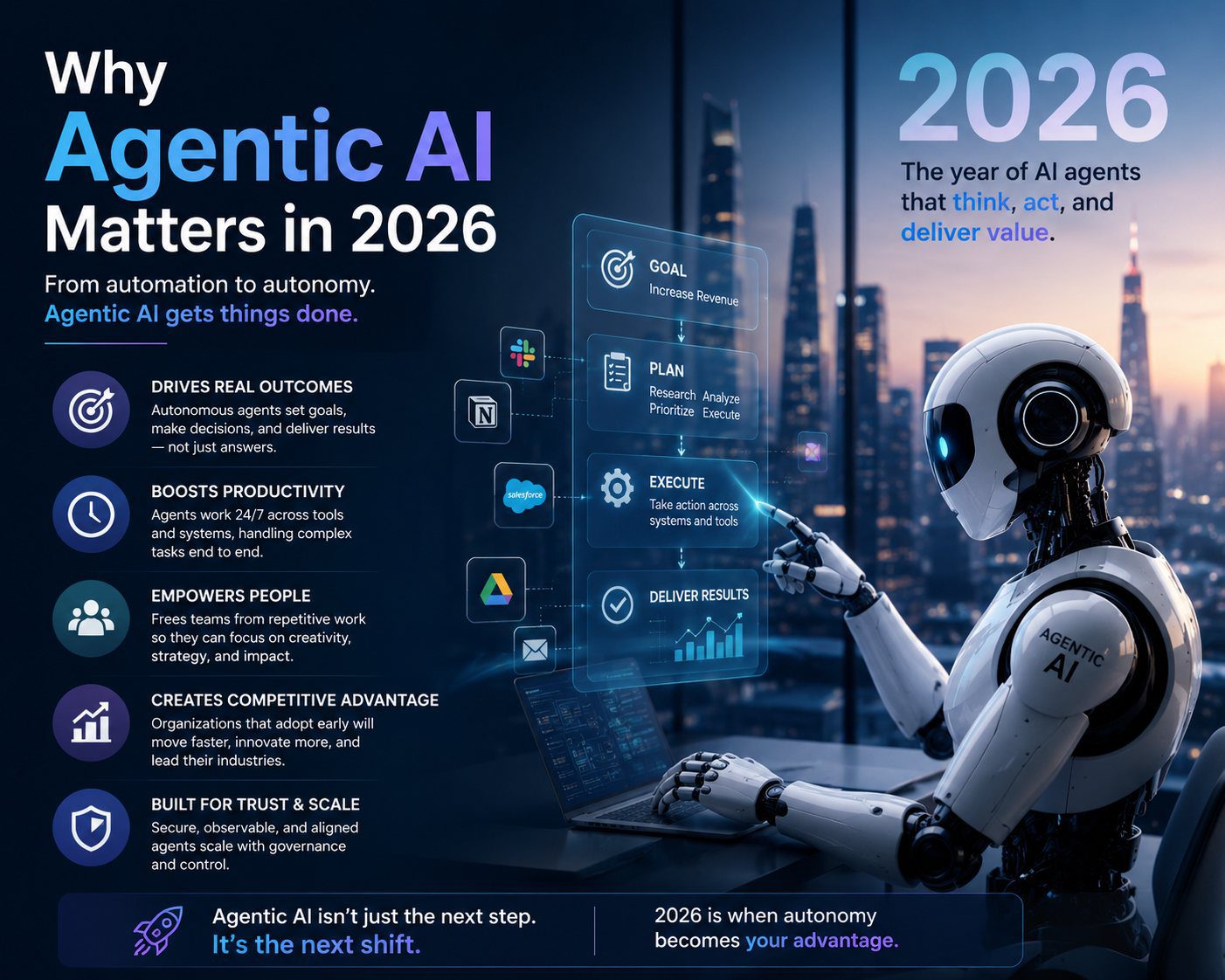
Agentic AI addresses this challenge by helping businesses analyze data faster, automate decision-making, and improve campaign performance. Instead of spending valuable time on repetitive operational tasks, marketing teams can focus on creative thinking, strategic planning, and long-term business growth.
Industry experts increasingly recognize autonomous AI agents as a defining force behind the future of marketing because they enable organizations to make smarter decisions and execute campaigns with greater speed and efficiency.
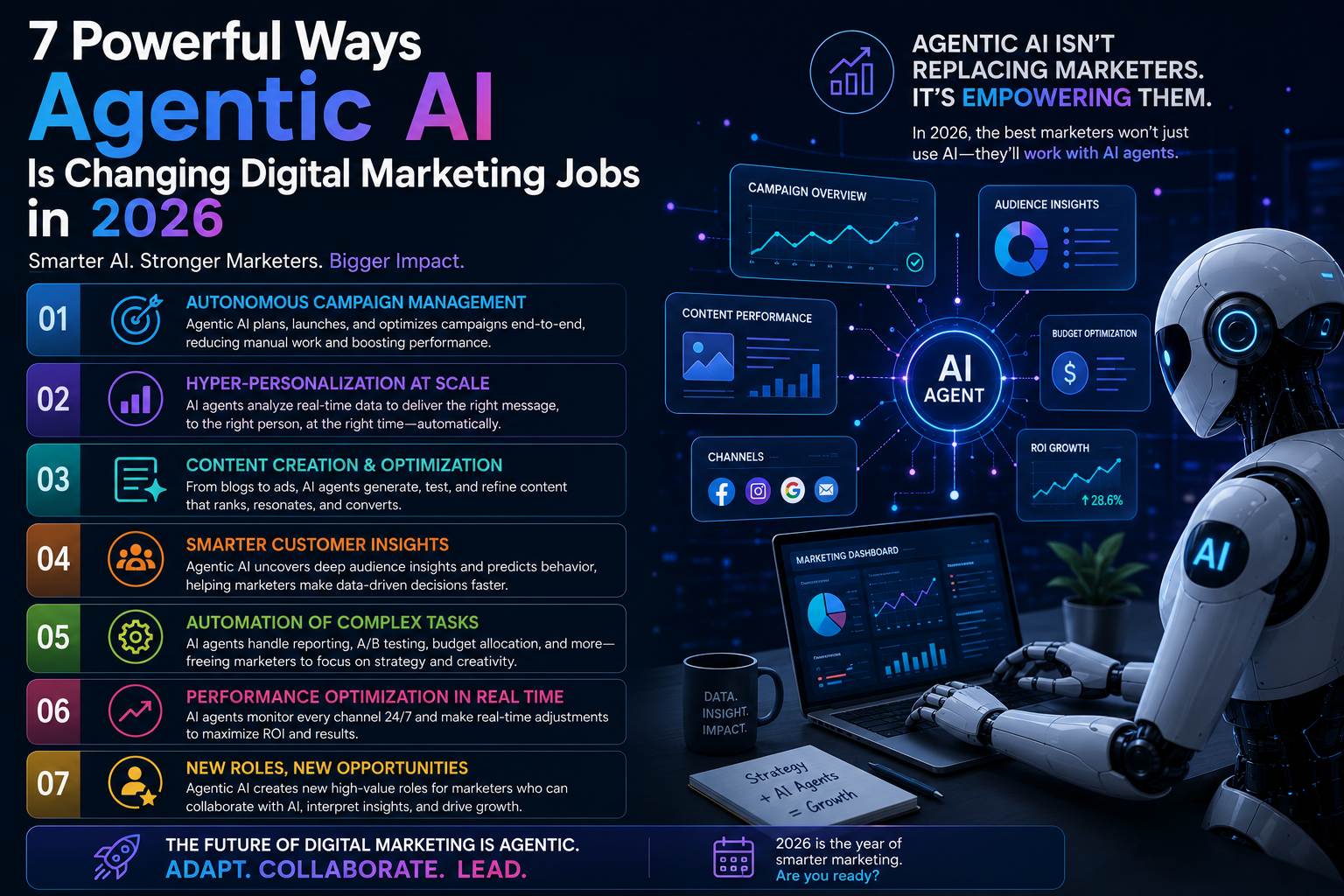
7 Powerful Ways Agentic AI Is Changing Digital Marketing Jobs in 2026
Smarter Content Creation
Content continues to be the backbone of successful digital marketing, and agentic AI is transforming the way marketers create and manage it.
These intelligent systems can automatically:
- Discover trending topics
- Perform keyword research
- Build content briefs
- Generate personalized content
- Optimize content based on performance
Rather than spending countless hours planning editorial calendars and repetitive research, marketers can rely on AI-powered content systems to handle routine processes while concentrating on creativity, storytelling, and brand messaging.
This is currently one of the most impactful applications of AI within modern digital marketing.
- Autonomous SEO Optimization
Search engine optimization is becoming increasingly data-driven, and agentic AI is taking SEO automation to the next level.
Instead of relying on periodic manual audits, agentic AI systems continuously monitor critical SEO metrics, including:
- Search ranking fluctuations
- Competitor activities
- Technical SEO issues
- Changes in search intent
- New content opportunities
These intelligent systems don’t just identify problems—they can also recommend improvements and, in many cases, implement optimizations automatically.
For SEO professionals, this means spending less time on repetitive analysis and more time developing strategies that drive sustainable organic growth.
Many students enrolled in the Best Digital Marketing in Surat are already learning how AI-powered SEO automation is expected to influence the future of digital marketing careers.
- AI-Powered Advertising Campaigns
One of the most exciting applications of agentic AI is its ability to automate and optimize digital advertising.
Modern AI-driven advertising platforms can:
- Optimize bids in real time
- Allocate budgets automatically
- Identify high-converting audience segments
- Generate new advertising creatives
- Improve overall conversion performance
Instead of manually adjusting campaigns every day, marketers can allow agentic AI to continuously monitor results and make data-driven optimizations around the clock.
As competition across digital advertising channels continues to increase, businesses that leverage AI-powered advertising gain a significant advantage by improving operational efficiency while maximizing return on investment (ROI).
- Advanced Customer Journey Management
Modern consumers expect highly personalized experiences at every stage of their interaction with a brand. Agentic AI helps businesses meet these expectations by intelligently managing the entire customer journey.
These autonomous systems can:
- Monitor customer behavior across touchpoints
- Detect purchase intent signals
- Deliver personalized product or content recommendations
- Automate follow-up communication
- Predict future customer actions
By analyzing customer data in real time, agentic AI enables businesses to create more meaningful interactions, improve customer satisfaction, and strengthen long-term customer relationships.
This growing capability is one of the primary reasons why forward-thinking organizations are making agentic AI in marketing a strategic priority.
- Social Media Management at Scale
Managing multiple social media platforms consistently can consume a significant amount of time and effort. Agentic AI simplifies this process by automating many routine social media tasks.
With agentic AI, marketers can:
- Schedule posts automatically
- Analyze audience engagement trends
- Monitor competitor activities
- Discover emerging viral opportunities
- Generate performance insights and reports
If you’re still deciding where to invest your social media efforts, it’s helpful to first understand which social media marketing strategies consistently produce business results. Once that strategy is established, AI can efficiently handle execution at scale.
As competition on social platforms continues to intensify, autonomous AI agents help businesses maintain a consistent online presence without increasing their workload.
Short-form video is also one of today’s highest-performing content formats. AI-powered tools can even assist marketers in determining the most effective publishing platform. For example, comparing Instagram Reels vs. YouTube Shorts can help businesses maximize organic reach and audience growth in 2026.
For agencies responsible for managing multiple client accounts, this level of automation can dramatically improve productivity and operational efficiency.
- New AI Marketing Career Opportunities
Although automation often raises concerns about job displacement, agentic AI is creating entirely new career opportunities within the marketing industry.
Some of the emerging roles include:
- AI Marketing Strategist
- Prompt Engineer
- AI Campaign Manager
- Marketing Automation Specialist
- AI Operations Manager
As organizations continue adopting advanced AI marketing solutions, professionals who possess expertise in both marketing strategy and artificial intelligence will become increasingly valuable.
For students and professionals planning their careers, developing skills in strategic thinking, creativity, AI management, and data-driven decision-making will be essential for long-term success.
Will Agentic AI Replace Digital Marketers?
The simple answer is no.
While agentic AI will significantly change how marketers work, it is unlikely to replace skilled professionals entirely. Instead, it will automate repetitive tasks while allowing marketers to focus on areas where human expertise remains irreplaceable.
Human marketers continue to bring unique strengths that AI cannot fully replicate, including:
- Creativity
- Brand storytelling
- Emotional intelligence
- Strategic leadership
- Relationship building
AI excels at processing information, analyzing data, and executing repetitive workflows, but humans remain responsible for innovation, business strategy, and meaningful customer relationships.
For professionals looking to stay competitive, the future belongs to those who learn how to work alongside AI rather than view it as a competitor. Developing AI literacy while strengthening uniquely human skills will be the key to long-term career growth.
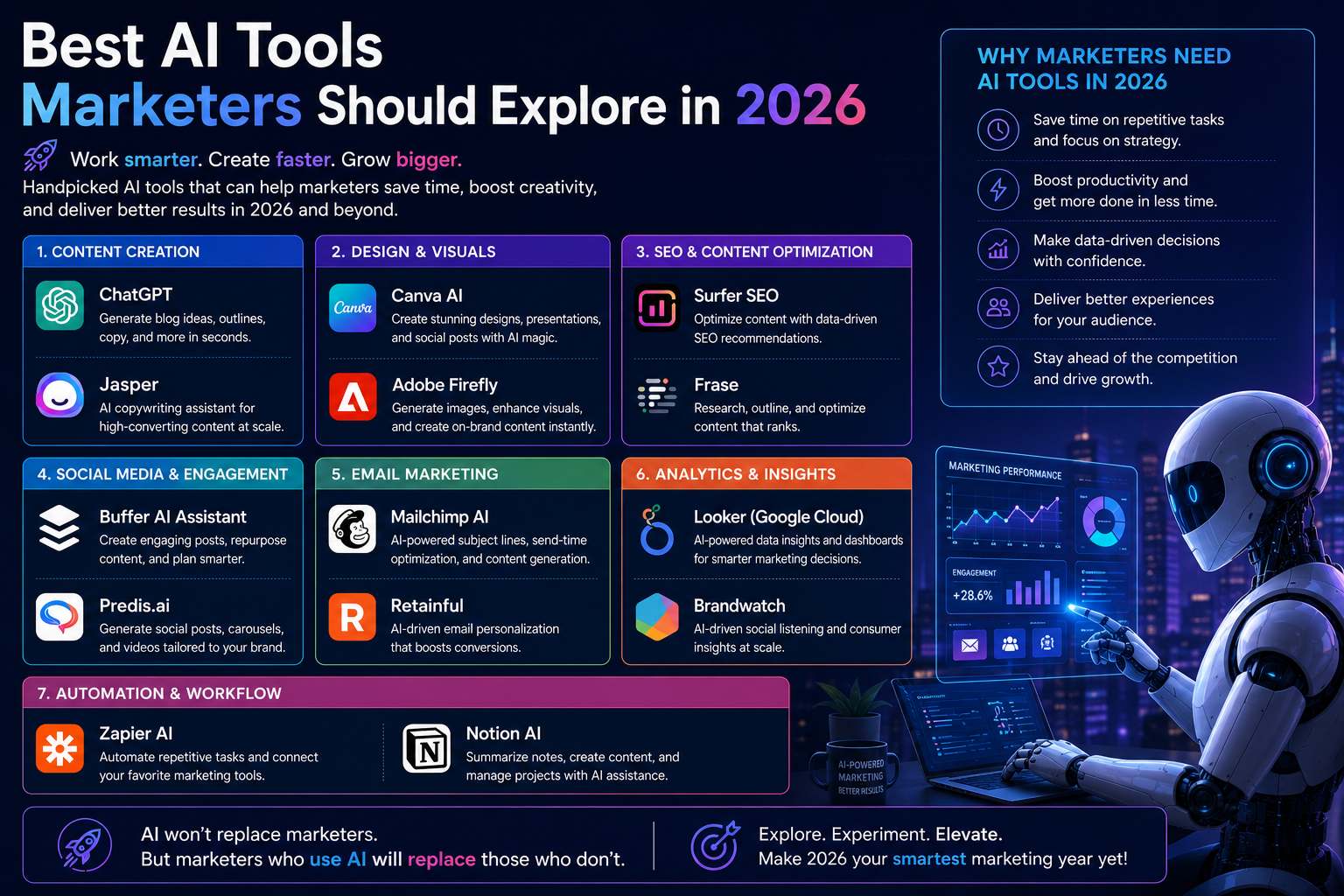
Best AI Tools Marketers Should Explore in 2026
Choosing the best AI marketing tools depends on your business objectives, team size, and overall marketing strategy. Different tools specialize in different areas of digital marketing.
SEO Tools
- ChatGPT
- Surfer SEO
- Semrush AI Features
Content Creation Tools
- Jasper
- Copy.ai
- Claude
Advertising Tools
- Google Ads AI
- Meta Advantage+
- Performance Max
Analytics Tools
- GA4 Insights
- Tableau AI
- Looker Studio AI
Marketing Automation Tools
- Zapier AI
- HubSpot AI
- Salesforce Einstein
Each of these platforms helps marketers improve efficiency, automate repetitive work, and make better data-driven decisions. Selecting the right combination of tools depends on your organization’s goals and marketing requirements.
Challenges and Risks of Agentic AI in Marketing
Although agentic AI offers significant advantages, businesses should also be aware of the challenges that come with adopting autonomous AI systems. Successful implementation requires balancing automation with responsible oversight.
- Data Privacy
Agentic AI relies heavily on customer and business data to make informed decisions. Organizations must ensure their AI systems comply with data privacy regulations and protect sensitive customer information throughout every stage of data processing.
- AI Bias
The quality of AI decisions depends on the quality of the data it receives. If training data is incomplete or biased, AI systems may produce unfair, inaccurate, or misleading outcomes that negatively impact marketing campaigns.
- Human Oversight
Even the most advanced autonomous AI solutions require regular monitoring. Human supervision helps ensure AI-generated decisions remain aligned with business objectives, brand values, and customer expectations.
- Ethical Considerations
As AI becomes increasingly involved in marketing decisions, transparency and responsible AI practices become more important than ever. Businesses should use AI ethically while maintaining customer trust and accountability.
- Accuracy Limitations
Despite rapid advancements, agentic AI is not infallible. Autonomous systems can still make mistakes, making human review essential before implementing critical business decisions.
Organizations that achieve the best results view AI as a collaborative partner rather than a complete replacement for human expertise.
How Businesses Can Start Using Agentic AI Today
Adopting agentic AI doesn’t require transforming every business process overnight. A gradual, structured approach often produces the most sustainable results.
Step 1: Identify Repetitive Tasks
Begin by identifying marketing activities that consume excessive time and resources. Routine, repetitive tasks are often the best candidates for AI automation.
Step 2: Choose the Right AI Tools
Select AI marketing platforms that align with your business goals, workflows, and long-term objectives. Choosing the right technology foundation is critical for success.
Step 3: Train Your Team
Equip employees with the knowledge and skills required to effectively operate, manage, and collaborate with AI systems. Human expertise remains an essential part of successful AI adoption.
Step 4: Measure Performance
Track key performance indicators such as productivity, campaign efficiency, and marketing outcomes to evaluate the effectiveness of AI implementation.
Step 5: Scale Successful Automation
Once initial AI initiatives demonstrate positive results, gradually expand automation across additional marketing functions and business departments.
Starting with smaller AI projects often creates a stronger foundation for long-term success and organization-wide adoption.
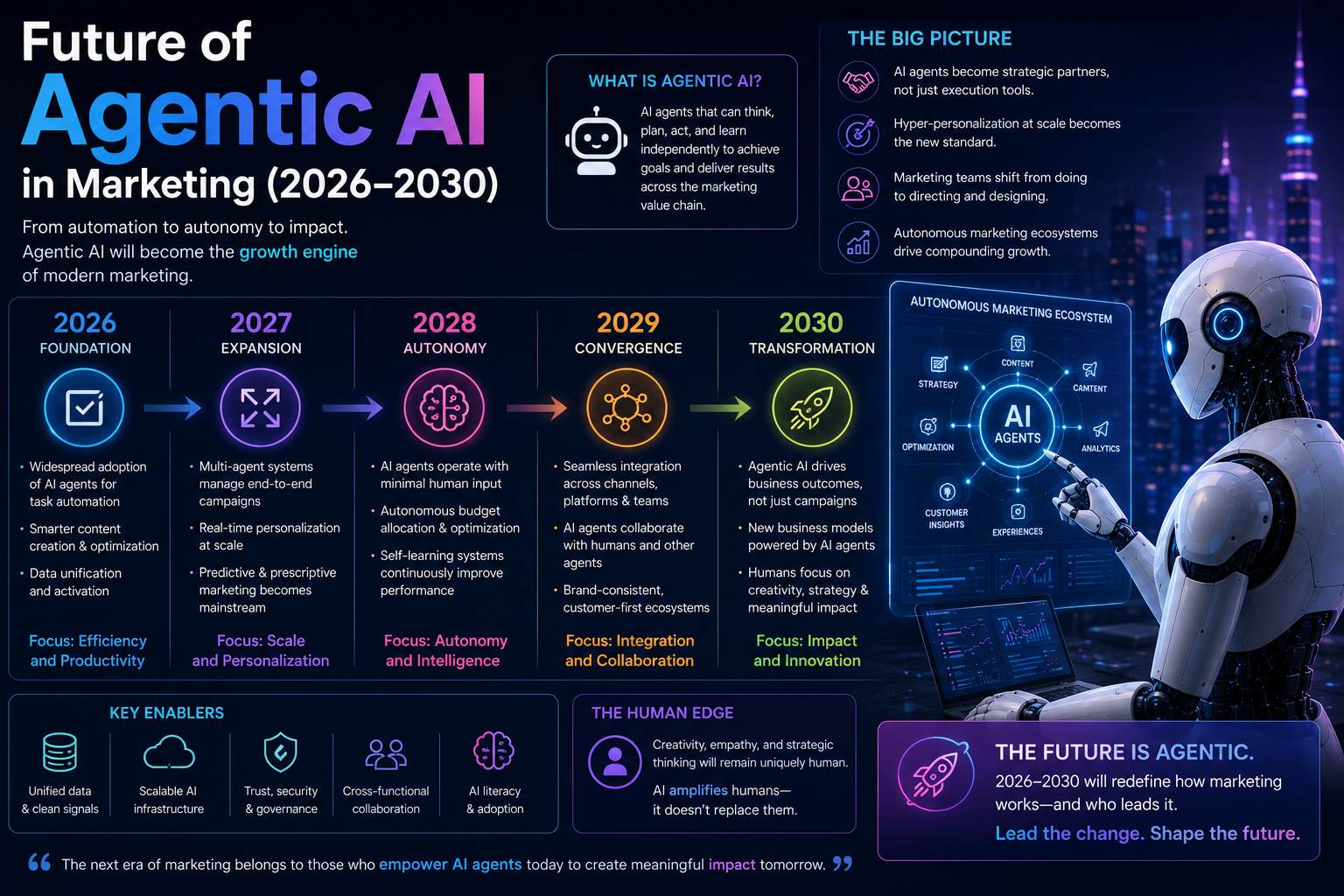
Future of Agentic AI in Marketing (2026–2030)
The coming years are expected to bring significant advancements in AI-powered marketing as autonomous systems become more sophisticated and deeply integrated into business operations.
Some of the major developments we can expect include:
- Autonomous marketing teams
- Smarter AI-driven campaigns
- Hyper-personalized customer experiences
- Real-time predictive decision-making
- Fully integrated marketing workflows
Businesses that embrace agentic AI early will be better positioned to improve efficiency, deliver exceptional customer experiences, and gain a competitive advantage in an increasingly digital marketplace.
Ultimately, the future of marketing will be shaped by collaboration between human creativity and intelligent AI systems, with each complementing the other’s strengths.
Frequently Asked Questions
Agentic AI in marketing refers to autonomous AI systems that can analyze data, make decisions, and execute marketing tasks with minimal human intervention. Unlike traditional AI tools, it proactively works toward achieving predefined marketing goals.
Traditional AI primarily provides recommendations and requires human approval before taking action. Agentic AI goes a step further by independently making decisions, automating workflows, and continuously optimizing marketing activities.
No. While agentic AI automates repetitive tasks and improves operational efficiency, marketers remain essential for creativity, strategic planning, emotional intelligence, brand storytelling, and relationship building.
AI helps businesses automate routine tasks, improve personalization, optimize campaigns, analyze large volumes of data, enhance customer experiences, and support faster, data-driven decision-making.
There is no single best AI solution for every business. The ideal choice depends on your marketing objectives, team size, and specific needs. Popular options include ChatGPT, Surfer SEO, Jasper, Google Ads AI, HubSpot AI, and Salesforce Einstein.