
Generative engine optimization is the practice of structuring your website, content and brand signals so AI systems — Google AI Overviews, AI Mode, ChatGPT, Gemini, Perplexity and Copilot — can retrieve, understand, trust and cite your business inside their generated answers. Classic SEO wins you a blue link. Generative engine optimization wins you the answer itself. If you run a business in India and your organic traffic has flattened this year even though your rankings look healthy, you are not imagining it. Something structural has changed in how people find brands online, and generative engine optimization is the discipline that responds to it.
Table of Contents
ToggleKey Takeaways
- Generative engine optimization is about being cited inside AI answers, not about ranking position.
- Answer engine optimization is the on-page half of it: question heading, then a 40–60 word direct answer.
- AI Overviews and AI Mode need no special schema or AI text file — they need indexation, clarity and trust.
- To rank on ChatGPT you must fix Bing, not Google. That single change unlocks ChatGPT and Copilot together.
- Sound AI search optimization covers both indexes, both disciplines, and is measured with a monthly prompt panel rather than a rank tracker.
- Indian competition on generative engine optimization is still weak, which makes the next twelve months unusually cheap to win.
I run JD Digital Marketing, an Ahmedabad-based agency, and over the last twelve months almost every client conversation has opened with the same sentence: “We rank on page one, so why has the phone stopped ringing?” This guide is my full working answer — the same generative engine optimization framework we use internally, written out step by step so you can run it yourself.
What Is Generative Engine Optimization?
Generative engine optimization (commonly shortened to GEO) is the process of making your content the source a generative AI system chooses when it composes an answer for a user.
Traditional search returns a list. A user scans ten links, clicks two, and forms an opinion. A generative engine does that scanning for them. It reads dozens of pages, extracts the parts it judges accurate and well-structured, synthesises a single response, and cites a handful of sources underneath. Generative engine optimization is how you make sure your page is one of those cited sources rather than one of the dozens read and discarded.
The critical mental shift is this: generative engine optimization is not about a ranking position. It is about extraction and citation. A page can rank fourth and still be the source an AI quotes. A page can rank first and be ignored completely. That gap is the entire subject of generative engine optimization.
Generative Engine Optimization vs Traditional SEO
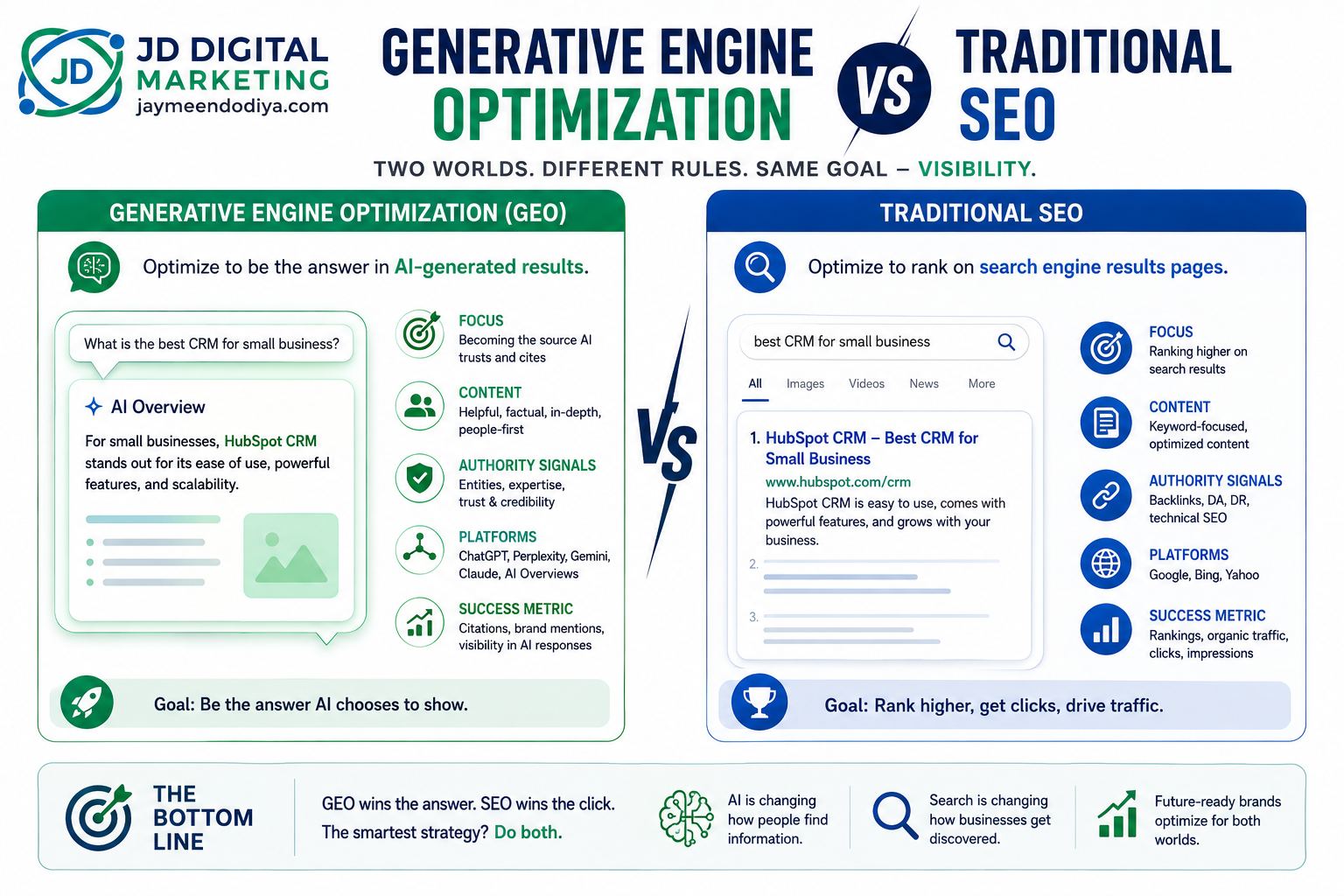
The honest answer is that generative engine optimization does not replace SEO — it sits on top of it. Google’s own documentation on AI features and your website is unusually blunt about this: a page must be indexed and eligible to appear in Search with a snippet before it can be shown in AI Overviews or AI Mode. There is no separate AI index and no secret markup file that unlocks AI Overviews.
So the foundations still matter. What changes is the layer you build on top of them.
Dimension | Traditional SEO | Generative Engine Optimization |
|---|---|---|
Goal | Rank in the top 10 | Be cited inside the generated answer |
Unit of value | The page | The passage, the sentence, the fact |
Target | Keywords | Entities, questions and intents |
Success metric | Clicks, CTR, position | Citations in AI Overviews, brand mentions |
Content shape | Long, keyword-led | Answer-first, structured, verifiable |
Trust signal | Backlinks | Backlinks plus first-hand experience |
Primary surfaces | Google, Bing | AI Overviews, ChatGPT, Gemini, Perplexity |
Nothing in the right-hand column contradicts the left. Generative engine optimization is additive. Any agency selling it as a replacement for SEO is selling you a story rather than a strategy.
Where Answer Engine Optimization Fits In
Answer engine optimization is the closely related discipline of formatting content so it can be lifted directly as a definitive answer — in featured snippets, voice results, people-also-ask boxes and AI Overviews.
The relationship is straightforward. Answer engine optimization is largely about format: short, self-contained, quotable answers placed immediately under a clear question heading. Generative engine optimization is broader — it covers that format plus entity clarity, source authority, structured data, technical crawlability and off-site reputation.
You cannot do generative engine optimization well without doing answer engine optimization first, because a machine that cannot cleanly extract your answer will never cite it. In practice we treat answer engine optimization as the on-page craft and generative engine optimization as the whole-brand programme. Answer engine optimization gets you quotable; generative engine optimization gets you trusted.
AEO, GEO, AIO and SXO — The Four Layers Explained
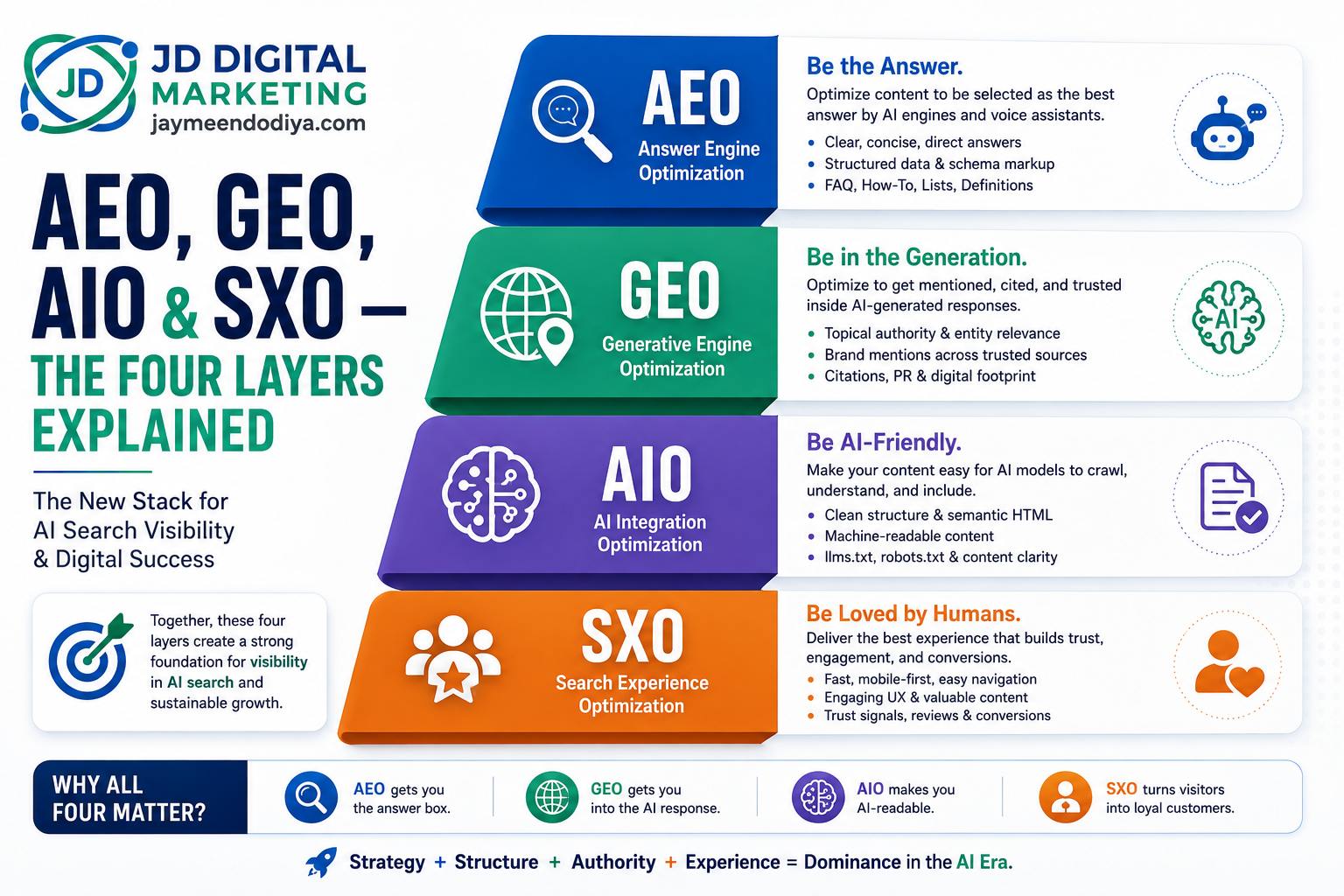
Marketers throw these acronyms around loosely. Here is how we define them at JD Digital Marketing, and how we sequence them:
- AEO (Answer Engine Optimization) — structuring individual answers for extraction. Question headings, 40–60 word direct answers, definition sentences, comparison tables, FAQ schema. Answer engine optimization is the cheapest win on this list.
- GEO (Generative Engine Optimization) — making your entire domain a preferred source for generative systems. Entity consistency, topical depth, original data, citation-worthy assets, and technical access for AI crawlers.
- AIO (AI Optimization) — the umbrella term for adapting the whole marketing operation to AI-mediated discovery, including how you use AI internally. We go deeper on this in our guide to AI for digital marketing.
- SXO (Search Experience Optimization) — what happens after the click. Speed, layout stability, scannability, trust cues, and a conversion path that does not fight the visitor.
Run in that order, the four layers compound. Run them out of order — SXO before answer engine optimization, say — and you polish a page nobody is reading.
Why Generative Engine Optimization Matters for Indian Businesses in 2026
Let me put numbers around the shift, because “AI is changing search” has been repeated into meaninglessness.
Gartner forecast that traditional search engine volume will drop 25% by 2026 as users move queries into chatbots and virtual agents. That is a quarter of the demand you currently compete for moving to a surface where classic ranking does not apply. Gartner’s analyst described generative AI tools as “substitute answer engines” — which is precisely why answer engine optimization stopped being optional and generative engine optimization became a budget line.
For Indian businesses specifically, three local factors sharpen the urgency.
Zero-Click Search Is Now the Default Behaviour
Indian search is overwhelmingly mobile and increasingly conversational. Users type full questions, use voice input in English and Hinglish, and accept the first confident answer they receive. When that answer arrives inside the results page, the click never happens — and a click that never happens cannot be tracked, retargeted or converted.
Generative engine optimization is the only lever that gives you presence in that no-click moment. If an AI Overviews panel or a Perplexity answer about “best CRM for small businesses in India” names your brand three times, you have won something a rank tracker will never show you. This is also why AI search optimization needs its own measurement plan, which we cover in Step 9 — and why the ability to rank on ChatGPT belongs in the same scorecard as your AI Overviews presence.
Competition Is Softer Here Than You Think
This is the opportunity, and it is closing fast. Most Indian websites have done no serious AI search optimization work at all. Schema is missing or broken. Author bios are absent. Business details differ between the website, Google Business Profile and directory listings. Pages open with three paragraphs of throat-clearing before the answer appears.
Every one of those is a generative engine optimization defect, and every one is fixable in weeks. In competitive Western markets you are fighting brands that fixed these in 2024. In most Indian verticals, you are fighting nobody — which makes early AI search optimization unusually cheap here.
Generative engine optimization is the only lever that gives you presence in that no-click moment. If an AI Overviews panel or a Perplexity answer about “best CRM for small businesses in India” names your brand three times, you have won something a rank tracker will never show you. This is also why AI search optimization needs its own measurement plan, which we cover in Step 9 — and why the ability to rank on ChatGPT belongs in the same scorecard as your AI Overviews presence.
What This Means for Ahmedabad and Tier-2 Markets
Local intent has quietly become AI intent. “Best CA firm near Prahlad Nagar”, “affordable interior designer Ahmedabad”, “which digital marketing agency in Ahmedabad suits startups” — these are now routinely asked conversationally, and the AI answer is assembled from your website copy, your Google Business Profile, your reviews and whatever third-party lists mention you.
Local generative engine optimization is therefore roughly 60% off-site. Your NAP consistency, review volume and sentiment, and presence on genuinely relevant listings feed the answer as much as your homepage does. If you want the on-site half handled professionally, that work sits inside our SEO services in Ahmedabad.
How AI Search Engines Actually Choose Their Sources
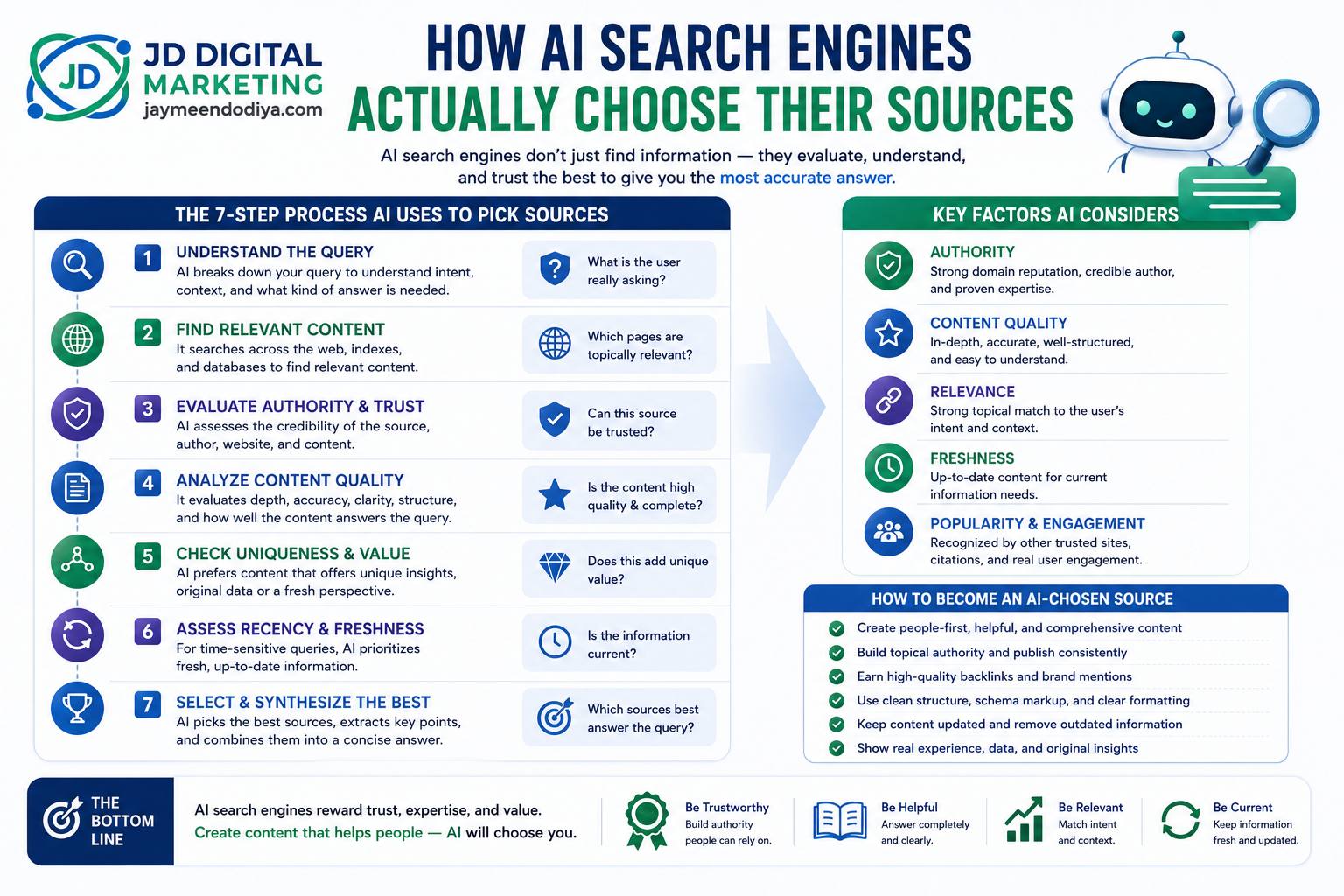
You cannot optimise for a black box you have never looked inside. Here is what is publicly known about each surface, and what it implies for practical AI search optimization.
Google AI Overviews and AI Mode
Google’s documentation confirms AI Overviews and AI Mode use a query fan-out technique: the system issues multiple related sub-searches across subtopics and data sources, then assembles the response from what it finds. That single detail should change how you plan content.
Fan-out means your page is not competing for one query. It is competing for a cloud of sub-questions the user never typed. A page about “digital marketing pricing” that also answers “what is included in a retainer”, “how long before SEO works” and “what do Ahmedabad agencies charge monthly” has four chances of being pulled into AI Overviews instead of one. Structuring for that breadth is the most underrated move in generative engine optimization.
Google also states plainly that there are no additional technical requirements, no special schema and no AI-specific text file needed to appear in AI Overviews. Their guide to optimizing for generative AI search is the single most useful free resource on generative engine optimization, and it is worth reading before you buy any tool.
What Google Says You Can Safely Ignore
This is the part of the guide most agencies skip, because it deletes half of what they sell. Google’s own position is that the following do nothing for visibility in AI Overviews:
- llms.txt and similar “AI files”. Google Search does not use them. Maintaining one is harmless — it simply will not help your AI Overviews presence.
- “Chunking” content into tiny fragments. There is no requirement to break pages up for machines. Google’s systems handle multiple topics on one page.
- Rewriting content specifically for AI systems. They understand synonyms and intent; you do not need to capture every phrasing variant.
- Manufactured brand mentions. Google explicitly calls out seeking inauthentic mentions as less useful than it appears, and their spam systems are built to catch it.
- Over-investing in structured data alone. Useful for rich results, not required for AI Overviews.
Notice what survives that list: original content, clean technical structure and genuine authority. That is the whole of honest generative engine optimization, and it is the only AI search optimization worth paying for.
What Actually Correlates With AI Overviews Citations
Across the client sites we track, the patterns that show up most consistently in pages cited by AI Overviews are:
- A direct answer within the first 60 words of the relevant section — textbook answer engine optimization.
- A question-shaped H2 or H3 immediately above that answer.
- Specific, checkable details — numbers, dates, named tools, named locations.
- Clean HTML where important content is real text, not text baked into an image.
- An identifiable author with a real bio and a real credential.
None of these are exotic. All of them are skipped by most sites, which is exactly why generative engine optimization still has low-hanging fruit in India.
What we do not see correlating with AI Overviews citations is word count for its own sake. Two of the most frequently cited client pages we track are under 900 words. They simply answer a narrow question completely. If your AI search optimization plan is “publish longer articles”, you have misread the problem.
How to Rank on ChatGPT
The question we are asked most often is how to rank on ChatGPT, and it deserves a precise answer because the mechanics differ from Google’s. Most guides on how to rank on ChatGPT skip the one detail that decides the outcome.
When ChatGPT browses the live web, its retrieval leans heavily on Bing’s index rather than Google’s. That has a direct consequence: if you want to rank on ChatGPT, your Bing presence is not optional. Many Indian sites are well indexed in Google, barely indexed in Bing, and then wonder why they never surface in AI answers. Fixing indexation is usually the single largest step towards being able to rank on ChatGPT at all.
Think of it as a second front in your AI search optimization plan: Google work earns you AI Overviews, Bing work earns you ChatGPT. Skip one and half the market never sees you.
The practical AI search optimization checklist to rank on ChatGPT looks like this:
- Verify your site in Bing Webmaster Tools and submit your XML sitemap.
- Enable IndexNow so new and updated URLs are pushed for near-instant crawling — a quiet prerequisite if you want to rank on ChatGPT quickly after publishing.
- Confirm robots.txt does not block AI retrieval crawlers, and check your CDN or firewall is not silently blocking them either.
- Make sure primary content renders as HTML text without requiring JavaScript execution.
- Build presence on the third-party sources ChatGPT tends to draw from — established industry publications, comparison and listing sites, and genuine community discussion.
That last point matters more than people expect. To rank on ChatGPT for a commercial query, being mentioned on other trusted sites often outweighs anything you write on your own domain. Generative systems triangulate: a claim repeated across several independent sources gets treated as fact. This is the part of generative engine optimization that cannot be shortcut with content volume.
One caution before you spend a rupee chasing this. You will find services promising to make you rank on ChatGPT within a fortnight. Retrieval is not a ranking table you can buy into, and no vendor controls what a model chooses to cite. Treat any guarantee to rank on ChatGPT the same way you would treat a guaranteed Google position — as a reason to walk away.
Perplexity, Gemini and Copilot
Perplexity is the most transparent of the group — it shows its sources openly, which makes it an excellent free diagnostic tool for AI search optimization. Ask it ten questions your customers ask, note which domains it cites, and you have a competitor list built on the metric that now matters.
Gemini leans on Google’s index and inherits Google’s quality signals, so strong classic SEO carries over well and AI Overviews wins often translate across. Copilot, like ChatGPT, is Bing-weighted — meaning the work that helps you rank on ChatGPT usually lifts Copilot for free. The practical upshot for AI search optimization in India: cover both indexes, Google and Bing, and stop treating Bing as an afterthought. Two indexes, four surfaces, one generative engine optimization programme.
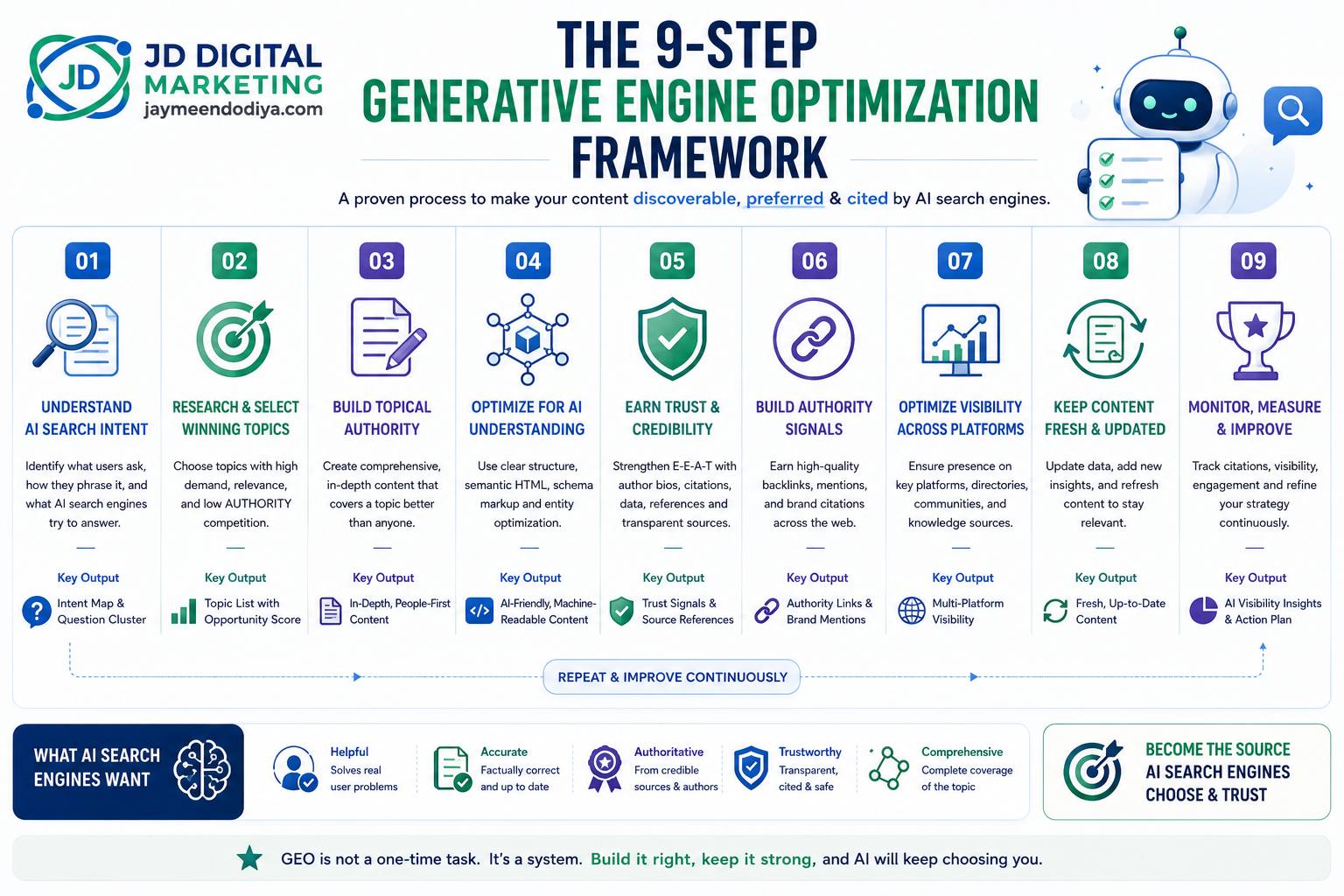
The 9-Step Generative Engine Optimization Framework
This is the sequence we actually run, ordered by leverage rather than by ease.
Step 1 — Rebuild Content Around Answer-First Blocks
Every section of every important page should follow one shape: a question-shaped heading, a 40–60 word direct answer, then supporting detail.
This is the core of answer engine optimization and the highest-leverage single change most Indian sites can make. Move your conclusion to the top. Context, caveats and examples still belong on the page — they belong after the answer, not before it.
A quick test: take any H2 on your site, read only the first two sentences beneath it, and ask whether that fragment would stand alone as a correct, useful answer if a machine lifted it out of context. If not, rewrite it. Do this across twenty pages and your answer engine optimization baseline improves more than any tool purchase would deliver.
Be clear about why this works, though. Google is explicit that you do not need to rewrite content for machines, and warns against fragmenting pages into artificial chunks. Answer-first structure earns its place because humans scan that way — the machine readability is a side effect, not the justification. If a change makes the page worse for a reader, it is not answer engine optimization, it is superstition.
Step 2 — Own an Entity, Not Just a Keyword
Generative systems reason about entities — people, organisations, places, products — not strings. Serious generative engine optimization makes your brand legible as an entity.
Practically: one canonical business name used identically everywhere; consistent address and phone across your site, Google Business Profile and every listing; an Organization schema block on the homepage with sameAs links to verified social profiles; and a genuine About page stating who you are, when you started, where you operate and what you specialise in.
Our about page exists as much for machines as for humans, and that is not cynical — it is the same information a careful customer wants.
Step 3 — Ship Structured Data That Matches Your Visible Text
Structured data does not magically create AI visibility. It removes ambiguity, and ambiguity is what gets you filtered out. Google’s introduction to structured data is the reference to follow, and the vocabulary itself lives at Schema.org.
The types that earn their keep for most Indian service businesses:
- Article with author, datePublished and dateModified on every blog post.
- FAQPage on pages with a genuine question-and-answer block — the schema companion to answer engine optimization.
- LocalBusiness with precise geo and opening hours on your contact page.
- Organization with sameAs and logo on the homepage.
- BreadcrumbList sitewide.
One rule overrides all of them: markup must match what a human sees. Google’s guidance is explicit that structured data should reflect visible content. Mismatched schema is a fast route to being distrusted, and distrust is fatal to generative engine optimization.
Where Most Sites Get Schema Wrong
Three failures appear in almost every audit: FAQ schema describing questions that are not on the page; an Article dateModified that updates on every cache rebuild without real content change; and LocalBusiness data disagreeing with the Google Business Profile. Each one teaches the system your markup is unreliable.
Step 4 — Publish First-Hand Experience and Original Data
Here Google’s E-E-A-T framework and generative engine optimization converge completely. Google’s guidance on creating helpful, reliable, people-first content asks a simple question: does this content demonstrate first-hand expertise?
Generative systems are drowning in restated generalities, because generating restated generalities is exactly what they do. What they cannot manufacture is your proprietary experience — the campaign that failed and why, the actual cost range you charge, the anonymised client result with real numbers, the mistake that cost three months.
Original data is the strongest citation magnet available to a small agency. One honest post like our breakdown of digital marketing cost in Ahmedabad — real ranges, real inclusions — earns citations in AI Overviews that a thousand words of generic advice never will. If you publish one thing this quarter for your generative engine optimization programme, make it something only you could have written.
Step 5 — Fix the Technical Layer of AI Search Optimization
Technical AI search optimization is unglamorous and non-negotiable. If a retrieval system cannot fetch and parse your page, no amount of writing rescues it — this is the floor beneath every other layer.
- Crawl access. Check robots.txt, then check your CDN and WAF rules separately. Bot-fighting settings block AI crawlers by default on many Indian hosting setups and the owner usually has no idea.
- Text availability. If important copy appears only after JavaScript runs, assume some retrieval systems never see it.
- URL structure. Clean, service-led and keyword-led URLs. /generative-engine-optimization/ beats /blog/post-482/ every time.
- Speed and stability. Google’s Core Web Vitals thresholds remain the practical benchmark and double as your SXO baseline.
- Internal linking. Google explicitly lists internal links as a way to make content findable for AI features. Use descriptive anchors, never “click here”.
If your site runs on an ageing theme with a plugin stack fighting itself, a rebuild often beats a patch — which is why our website development work now ships with this AI search optimization checklist applied by default.
Step 6 — Earn Citations on Sources the Models Already Trust
Off-site is where generative engine optimization diverges most sharply from classic link building. You are not chasing domain authority. You are chasing corroboration.
One important caveat, and it is Google’s own: chasing inauthentic mentions does not work. Paying for a hundred scraped directory citations is not corroboration, it is noise, and Google’s spam systems are built to discount it. What counts is being genuinely written about by people who had a reason to write about you.
So prioritise industry publications that genuinely cover your sector; curated local and national listings relevant to your category; real participation in communities where your customers ask questions; original commentary others choose to quote; and podcast or webinar appearances that leave a transcript on somebody else’s domain.
The test is simple. Ask Perplexity a commercial question in your category and look at which domains it cites. Those are your generative engine optimization targets. Everything else is noise.
Step 7 — Optimise the Post-Click Experience (SXO)
Winning the citation is worthless if the visitor bounces. Search experience optimization closes the loop that answer engine optimization opens.
What moves the needle for Indian mobile traffic: a visible answer above the fold matching the query that brought them in; no interstitial popup within the first 15 seconds; a table of contents on long pages; WhatsApp and call buttons that are genuinely thumb-reachable; and a form asking three fields, not nine.
Our Google Ads clients see the same lift from the same fixes — a useful reminder that SXO improvements pay across every channel at once.
Step 8 — Localise Properly for the Indian Market
Generic global content loses to specific local content in AI answers, because specificity is easier to verify.
Name cities and neighbourhoods. Quote prices in rupees with realistic ranges. Reference platforms your audience actually uses — UPI, WhatsApp Business, Google Business Profile, JustDial. Answer questions in the phrasing Indians actually use, including Hinglish variants, and cover GST implications where relevant. Our sector guides, like the one on digital marketing for real estate in Ahmedabad, are built on exactly this principle, and it is the same principle that makes local generative engine optimization work.
Step 9 — Measure AI Visibility, Not Just Rankings
You cannot manage what you refuse to measure, and rank trackers do not measure AI presence. A workable free measurement routine for generative engine optimization:
- Search Console’s Generative AI performance report. Google now ships a dedicated report for exactly this, alongside the standard Performance report where AI Overviews and AI Mode impressions are also counted under the Web search type. Check both, and watch for the classic pattern of the AI era: impressions rising while clicks fall. Note too that your site must be included in Search generative AI features in Search Console to be eligible for display at all — worth confirming before you conclude your generative engine optimization is failing.
- Be sceptical of third-party “AI visibility” scores. Google states directly that no third-party tool has access to its internal ranking or AI systems. Use them for workflow, never as truth.
- Manual prompt panel. Write 20 real customer questions. Run them monthly through ChatGPT, Gemini and Perplexity. Log whether your brand appears, where, and which URL is cited. This is the only reliable way to know whether you now rank on ChatGPT for the questions that matter.
- Brand mention tracking. Set alerts on your brand and on “brand + category” phrases.
- Assisted conversions. Watch direct and branded-search traffic. Visitors influenced by AI Overviews frequently arrive later as direct traffic — the quiet payoff of good AI search optimization.
Set expectations with your team before you start. AI Overviews do not trigger on every query, and Google says so explicitly — they appear only where the system judges them additive. A month with fewer AI Overviews in your category is not necessarily a month your AI search optimization went backwards. Track the trend across a quarter, not week to week.
A Simple Monthly GEO Tracking Sheet
Five columns is enough: Prompt | Engine | Brand mentioned (Y/N) | URL cited | Competitor cited. Twenty rows, three engines, once a month. Sixty data points, about ninety minutes of work, and more insight into your generative engine optimization progress than most paid dashboards deliver.
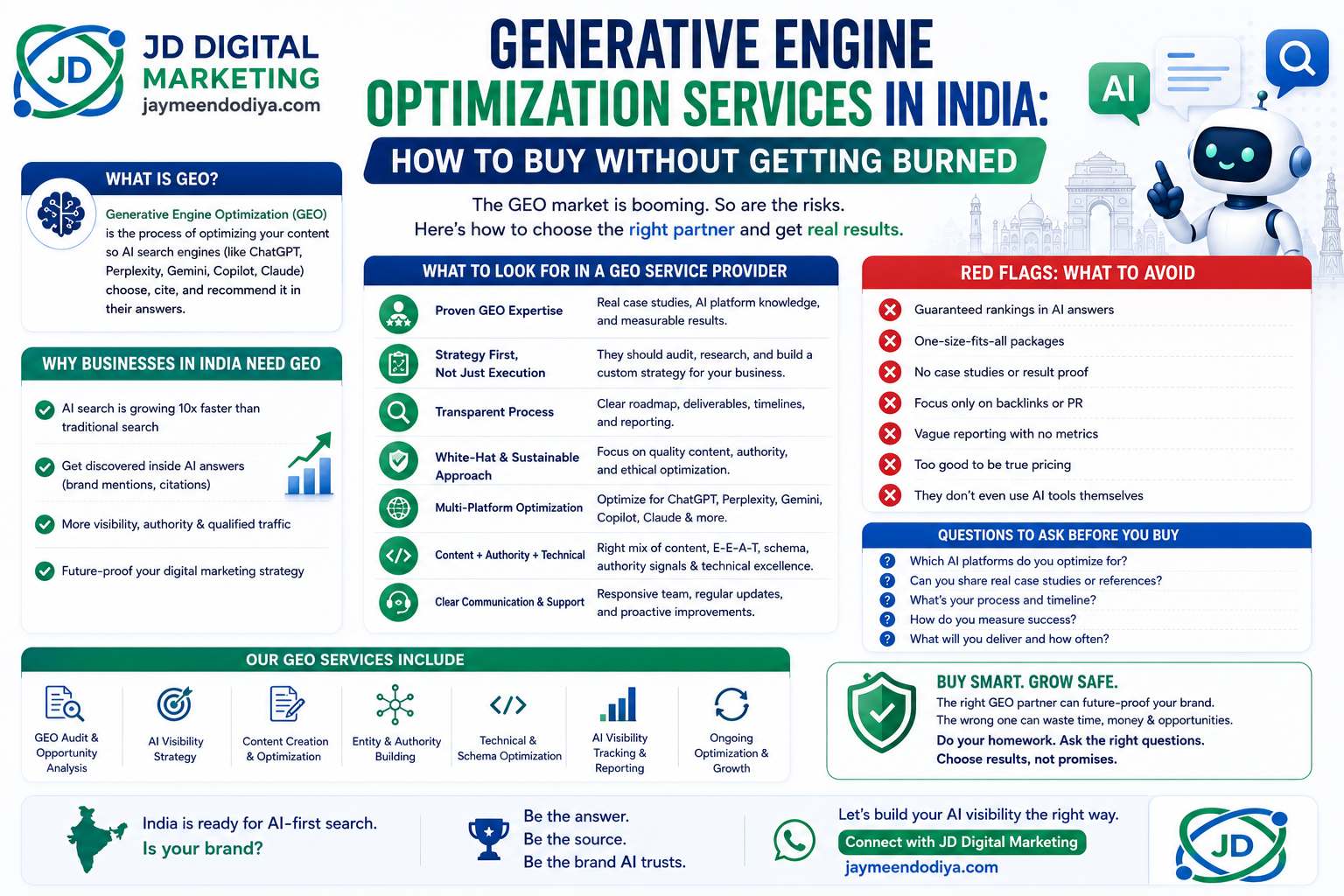
Generative Engine Optimization Services in India: How to Buy Without Getting Burned
The market for generative engine optimization services in India got loud very quickly, and loud markets attract opportunists. Here is how to filter.
Red Flags in a GEO Proposal
- Guaranteed placement in AI Overviews, or a promise to make you rank on ChatGPT by a fixed date. Nobody can guarantee either; Google states outright that indexing and serving are never guaranteed.
- A proposal that never mentions technical SEO. Generative engine optimization without indexation is decoration.
- Deliverables measured purely in article count.
- Heavy reliance on a single proprietary “AI visibility score” with no explanation of how it is calculated. Google is blunt that no third-party tool sees inside its systems, so treat any such score as a directional proxy for your generative engine optimization progress, never as a fact.
- No plan for off-site citations or reviews — meaning no real answer engine optimization or corroboration strategy.
What a Serious Engagement Should Include
A credible proposal for generative engine optimization services in India covers, at minimum: a technical and crawl-access audit; an entity and NAP consistency audit; a schema implementation plan; a content restructuring plan built on answer engine optimization principles; an original-data content plan; an off-site citation strategy; and a defined AI search optimization measurement routine with a documented monthly baseline.
If you would rather see all of this mapped against your own site before committing to anything, that is what our digital marketing services in Ahmedabad audit covers, and the first conversation costs nothing.
Common Generative Engine Optimization Mistakes
We audit a lot of Indian websites. The same seven mistakes appear again and again:
- Burying the answer. Three paragraphs of preamble before the useful sentence. Machines and humans both leave. This is the most common answer engine optimization failure we see.
- Publishing volume instead of substance. Forty thin AI-written posts earn fewer citations in AI Overviews than four genuinely original ones. Volume is not AI search optimization.
- Ignoring Bing entirely. This alone explains why many sites never rank on ChatGPT or in Copilot. If you do nothing else from this generative engine optimization guide, do this.
- Inconsistent entity data. Three different phone numbers across your site, listings and Google Business Profile.
- Schema that lies. FAQ markup for questions appearing nowhere on the page.
- No named author. Anonymous content struggles on E-E-A-T grounds and struggles harder in AI selection.
- Measuring only rankings. You conclude your generative engine optimization is failing while your citations in AI Overviews quietly climb.
None of these require a big budget to fix. They require someone to actually look.
FAQ
Generative engine optimization is making your website easy for AI systems to read, trust and quote, so your brand appears inside AI-generated answers on ChatGPT, Google AI Overviews, Gemini and Perplexity rather than only in the blue links below them.
Yes, but it depends on SEO rather than replacing it. Your page must be indexed and snippet-eligible before any AI system can cite it. Generative engine optimization adds an extraction-and-trust layer — answer engine optimization structure, entity clarity, structured data and off-site corroboration — on top of that foundation.
To rank on ChatGPT, focus on Bing rather than Google. Verify your site in Bing Webmaster Tools, submit your sitemap, enable IndexNow, ensure content renders as plain HTML text, and build mentions on independent third-party sites ChatGPT already draws from. Corroboration across sources matters more than on-page keyword work when you want to rank on ChatGPT.
No. Google states there is no special schema required for AI Overviews and that serving is never guaranteed. Structured data helps by removing ambiguity about what your page says and who published it, which improves your odds of appearing in AI Overviews — it does not buy you a slot.
Expect first measurable changes in AI Overviews presence within 60 to 90 days for a site with reasonable existing authority, and four to six months for a newer domain. Technical AI search optimization and entity fixes register fastest; citation-driven generative engine optimization gains compound more slowly, and the ability to rank on ChatGPT usually follows Bing re-indexation by a few weeks.
Yes. Being named inside an answer builds preference even without a click, and users who do click through from AI surfaces arrive better informed and closer to buying. Google has reported that clicks originating from result pages with AI Overviews are higher quality, with visitors spending more time on site — which is the quiet commercial case for answer engine optimization.
Most Indian agencies price AI search optimization as an add-on to an existing SEO retainer rather than a standalone service, because the technical and content foundations overlap heavily. Expect a one-time audit fee plus a monthly increment. Be sceptical of anyone quoting a premium for AI search optimization while ignoring your indexation and schema.
No. Answer engine optimization is the on-page discipline of making individual answers extractable. Generative engine optimization is the broader programme that also covers entity consistency, structured data, technical crawl access and off-site corroboration. Most brands should start with answer engine optimization and expand into full generative engine optimization from there.
Partly, and Google would say entirely — its official position is that optimizing for generative AI search is SEO. The label still earns its keep as a planning tool, because generative engine optimization forces you to budget for things classic SEO retainers ignore: Bing indexation so you can rank on ChatGPT, entity consistency, and monthly prompt testing. Call it generative engine optimization or call it modern SEO; just make sure those line items exist.